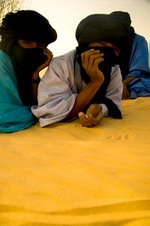
How do these foreign fighters end up killing themselves in Iraq?
The Washington Post has a fascinating article today on how young Moroccans are being recruited to fight jihad in Iraq.
"The big state for al-Qaeda is Iraq," said Mohamed Darif, a political science professor and terrorism expert at Hassan II-Mohammedia University in Morocco. "Al-Qaeda has the same strategy as the United States: It wants to win in Iraq so it can transform the whole region. They are fixated on Iraq."
According to the Post's sources, Al Qaeda has focused its recruitment efforts in Morocco in a small village in a hill station in the Rif mountains called Tetouan. As the Post reports:
Designated "watchers" hang around radical mosques and other places to look for young men angry about the conflicts in places such as Iraq and the Palestinian territories. For months, the watchers try to whip up the potential volunteers' emotions further and convince them that they have a religious duty to intervene.
"The recruitment does not exclusively take place in the poorest parts of society, nor in the category of illiterates," said Benmoussa, the interior minister. Instead, he said, recruiters "target a category of people that is extremely sensitive to what they consider international injustice."
Candidates are subjected to psychological assessments from a distance to determine if they are really willing to die for the cause.
This is because these Moroccan recruits are primarily used to carry out suicide missions once they get to Iraq. As Nick Pratt, a retired Marine colonel and terrorism expert at the George C. Marshall European Center for Security Studies in Garmisch-Partenkirchen, in Germany told the Post, "Suicide bombings are embraced by networks affiliated with al-Qaeda because they are more lethal and generate more publicity. He said a suicide attack, on average, causes six times as many deaths and 12 times as many injuries as a conventional attack, such as a roadside bomb explosion."
Moroccan authories believe that some 50 Moroccans have been lured to fight jihad in Iraq since 2003. According to the Post's sources, "the problem is worse in other Arab countries."






 Posts
Posts