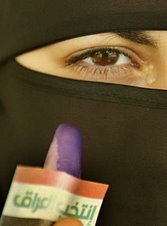
An "easy and reliable way of defeating all insurgencies everywhere"
But before you get too excited, beware that as the author of this approach, Edward Luttwak writes: "It is enough to consider these methods to see why the armed forces of the United States or of any other democratic country cannot possibly use them."
Nevertheless why not at least see what an "easy and reliable" method of counterinsurgency would involve.
From his article "Dead End" in the April issue of Harper's, I extract Luttwak's key points:
The simple starting point is that insurgents are not the only ones who can intimidate or terrorize civilians. For instance, whenever insurgents are believed to be present in a village, small town, or distinct city district—a very common occurrence in Iraq at present, as in other insurgency situations—the local notables can be compelled to surrender them to the authorities, under the threat of escalating punishments, all the way to mass executions.History is full of the successful application of this approach says Luttwak:
That is how the Ottoman Empire could control entire provinces with a few feared janissaries and a squadron or two of cavalry. The Turks were simply too few to hunt down hidden rebels, but they did not have to: they went to the village chiefs and town notables instead, to demand their surrender, or else. A massacre once in a while remained an effective warning for decades...He goes on to cite how well this technique worked for the Germans in World War Two: "As for the daring resistance attacks that feature in films," he writes, "they did happen occasionally, but not often, and not because of any lack of bravery in fighting the routinely formidable Germans but because of the terrible punishments they inflicted on the population."
Long before the Ottoman Empire, the Romans knew how to combine sticks and carrots to obtain obedience and suppress insurgencies. Conquered peoples too proud to accept the benefits of their rule, from public baths and free circus shows to reliable law courts, were “de-bellicized” (a very Roman idea). It was done by killing all who dared to resist in arms—it made good combat practice for the legions—by selling into slavery any who were captured in battle, by leveling towns that held out under siege instead of promptly surrendering, and by readily accepting as peaceful subjects and future citizens all who submitted to Roman rule...“They make a wasteland and call it peace” was the bitter complaint of a Scottish chieftain (as reported by Tacitus).
And how well it worked in Vietnam:
[T]he Viet Cong and North Vietnamese were skilled in using terror to secure their pervasive territorial control and very ready to use any amount of violence against civilians, from countless individual assassinations to mass executions, as in Hue in 1968. The Communist cause had its enthusiasts, “fellow travelers,” and opportunistic followers, but Vietnamese who were none of the above, and not outright enemies, were compelled to collaborate actively or passively by the threat of the violence so liberally used."That is exactly what the insurgents in Iraq are now doing," he writes, "and this is no coincidence." As he goes on to recap his argument:
All insurgencies follow the same pattern. Locals who are not sympathetic to begin with, who cannot be recruited to the cause, are compelled to collaborate by the fear of violence, readily reinforced by the demonstrative killing of those who insist on refusing to help the resistance. Neutrality is not an option.Contrast the terror approach, says Luttwak, with the American method of "de-bellicizing" the Iraqi insurgency:
[T]he capacity of American armed forces to inflict collective punishments does not extend much beyond curfews and other such restrictions, inconvenient to be sure and perhaps sufficient to impose real hardship, but obviously insufficient to out-terrorize insurgents.Since American forces can never hope to out-terrorize the insurgents, what, if any, is the alternative?
"The ordinary administrative functions of government can also be employed against the insurgents," writes Luttwak:
Insurgents everywhere seek to prohibit any form of collaboration or contact with the authorities, but they cannot normally prevent civilians from entering government offices to apply for obligatory licenses, permits, travel documents, and such. That provides venues for intelligence officers on site to ask applicants to provide information on the insurgents, in exchange for the approval of their requests and perhaps other rewards. This effective and straightforward method has been widely used, and there is no ethical or legal reason why it should not be used by the armed forces of the United States as well. But it does require the apparatus of military government, complete with administrative services for civilians.I get it: this must be the difficult and unreliable way of defeating an insurgency.
Now to understand why Luttwak thinks a military government as opposed to, say, the civilian Iraqi government needs to do this, you should read his article. Then again, maybe he thinks the Iraqi goverrment is the American military government.
Anyway, to see what another expert, David Kilcullen, civilian advisor to the Central Command in Iraq, said about Luttvak's approach, start here.







 Posts
Posts