traffic analysis

Monday, December 28, 2009

Statement from the righteous family of the Underwear Bomber

Umar Farouk Abdulmutallab


The family is righteous because they notified authorities that they feared he was preparing for some kind of terrorist action at least a month ago.  Here is their statement:
Our family, like the rest of the world, were woken up in the early hours of Saturday, 26th December, 2009 to the news of an attempt to blow up a plane by a young Nigerian man, who was later identified as Umar Farouk AbdulMutallab. Umar Farouk AbdulMutallab is the son of Alhaji (Dr.) Umaru AbdulMutallab, the head of this family.
Prior to this incident, his father, having become concerned about his disappearance and stoppage of communication while schooling abroad, reported the matter to the Nigerian security agencies about two months ago, and to some foreign security agencies about a month and a half ago, then sought their assistance to find and return him home. We provided them with all the information required of us to enable them do this. We were hopeful that they would find and return him home. It was while we were waiting for the outcome of their investigation that we arose to the shocking news of that day.
The disappearance and cessation of communication which got his mother and father concerned to report to the security agencies are completely out of character and a very recent development, as before then, from very early childhood, Farouk, to the best of parental monitoring, had never shown any attitude, conduct or association that would give concern. As soon as concern arose, very recently, his parents reported it and sought help.

The family will continue to fully cooperate with local and international security agencies toward the investigation of this matter, while we await results of the full investigation.
We, along with the whole world, are thankful to almighty God that there were no lives lost in the incident. May God continue to protect us all, amen.

Finally, as the matter is being investigated by the various agencies, and has already been mentioned in aU.S. court, the family requests that the press should regard this as the only statement it will make for now.

Thank you.
Signed,


The Mutallab Family
AbujaNigeria

Thursday, November 26, 2009

How Afghans assess the situation


The BBC reports:

Oxfam's chief executive said the message from ordinary people in Afghanistan was that "all sides must stop targeting civilians".
They wanted international forces to tighten their restrictions on air strikes and night raids and to investigate properly all allegations of harm to civilians, she said.
The Afghan people interviewed also wanted insurgents to "stop taking refuge in civilian areas, which puts normal Afghans on the front lines of the conflict", she added.
Seems fair enough to me.

Sunday, November 22, 2009

Afghans whup Taliban: 6-0

The New York Times reports:

American and Afghan officials have begun helping a number of anti-Taliban militias that have independently taken up arms against insurgents in several parts of Afghanistan, prompting hopes of a large-scale tribal rebellion against the Taliban.
The emergence of the militias, which took some leaders in Kabul by surprise, has so encouraged the American and Afghan officials that they are planning to spur the growth of similar armed groups across the Taliban heartland in the southern and eastern parts of the country.
Why now?  Apparently, some Afghans have had enough:
In July, a long-running dispute between local Taliban fighters and elders from the Shinwari tribe flared up. When a local Taliban warlord named Khona brought a more senior commander from Pakistan to help in the confrontation, the elders in the Shinwari tribe rallied villagers from up and down the valley where they live, killed the commander and chased Khona away.

The elders had insisted that the Taliban stay away from a group of Afghans building a dike in the valley. When Khona’s men kidnapped two Afghan engineers, the Shinwari elders decided they had had enough.

“The whole tribe was with me,” one of the elders said in an interview. “The Taliban came to kill me, and instead we killed them.”
How is the tribe doing?  They appear to be kicking the "stray dogs" you-know-whats.
Since the fight, the Taliban have been kept away from a string of villages in Achin District that stretch for about six miles. The elders said they were able to do so by forming a group of more than 100 fighters and posting them at each end of the valley.
Now imagine giving every man, woman, and child in Afghanistan - every school girl and her grandma - a cell phone so that every villager in trouble could call one of these local militias.  How much longer do you think their fathers, sons, and brothers would allow the Taliban survive a menacing visit to their homes or schools?

Forget road and school building.  Bring these people phone service and let them establish their own security and educational opportunities. 

Saturday, November 7, 2009

Finally some good news about Pakistan

Or at least hope that at last we'll have a reliable source of information.  

Pakistan Conflict Monitor, a website devoted to "research and analysis on the conflict in Pakistan" is now in the business, to paraphrase their mission statement, of systematically monitoring over 1,500 websites, as well as dozens of e-mailing lists and academic journals, to cull together the latest in academic research and insight on the conflict in Pakistan.

Sunday, November 1, 2009

Here's another good analysis of the US debate on Afghanistan

From Tom Ricks, who covered the US military for the Washington Post (2000-2008), and author of The Gamble, another must-read on US war strategy.

He comments on the differences between Tom Friedman, NYT's columnist and David Ignatius of the Washington Post.  As he writes:

Both are centrist middle-aged white men writing for major newspapers. Both also are successful authors, though the Rousseauian Friedman produces optimistic non-fiction works, while the more Hobbesian Ignatius writes dark thrillers about intelligence. Also, I think Friedman tends to be influenced a bit more by diplomats, while Ignatius seems a bit more plugged into the worlds of intelligence and the military.
Friedman, he writes:
thinks that Iraq is more important than Afghanistan and Pakistan. I disagree, but this may be in part because he lived in Lebanon and Israel, while I lived in Afghanistan. I think the situation in Afghanistan and Pakistan threatens the United States far more than anything in Iraq does. That is, I think Pakistan is deteriorating quickly and has weapons of mass destruction and Islamic extremists who are gaining ground, while Iraq is only deteriorating slowly, has no WMD (remember, Tom?) and its few Islamic extremists are on their heels.
Whereas Ignatius still believes that a surge could work in Afghanistan. But, as he goes on to say:
I wish Ignatius also had written about the need to have U.S. troops protect the people from the brutality and abuses of Afghan soldiers and police. The need for more U.S. forces isn't just about insurgents. The predatory behavior of some of them has driven Afghans into the arms of the Taliban. Having American units partnered with Afghan forces won't stop such abuses, but it will lessen them. For example, I am told there currently are five checkpoints between Spin Boldak and Kandahar, with official shakedowns of truck drivers at each. Such corruption is a tax on the stomachs of poor Afghans. Get rid of the unnecessary checkpoints, and have Americans around the other ones, and fewer Afghans will go hungry. 

Must-read on the recent CIA leak

The one about Karzai's "heroin-dealing" brother being a paid CIA asset.   Some excerpts from the article by Robert Haddick's Foreign Policy Small Wars blog.

As Haddick notes:

The Times's sources for this [leak] included "current and former American officials" including a former CIA officer and perhaps a senior U.S. military officer in Kabul. Karzai acknowledged aiding U.S. efforts but denied receiving any payments from the CIA.''

Haddick then poses the key questions:
Did frustration and moral outrage with Karzai's illicit activities lead U.S. officials to expose him as a paid CIA asset? It would certainly be understandable, for these officials may have a low opinion of him and perhaps by association his brother the president. But this collective outburst is folly and will make a nearly impossible task for the United States in Afghanistan only that much harder.
The U.S. officials who exposed Karzai are likely hoping that with his status now public, he will no longer be useful to the CIA. Perhaps they are hoping that the CIA will be too embarrassed to continue paying him. As the Times piece discusses, some officials believe that if the U.S. really wants better governance in Afghanistan, it must begin by getting rid of types like him.
But, as Haddick goes on to observe:
U.S. officials have to deal with Afghanistan society as it is, not as they wish it might be. With no history of a successful strong central government, and not much prospect of establishing it anytime soon, U.S. officials have to deal with local strongmen. If, perhaps like Ahmed Wali Karzai, the local strongman is both very powerful and equally unsavory, U.S. military, State Department, and CIA field officers will have to weigh the feasible alternatives, if any can be found. If there are no alternatives, U.S. officials will have to quietly decide whether the mission is worth the moral consequences.
Anyway, read the whole piece.

Thursday, October 29, 2009

Hillary warns Pakistan

From Bloomberg News:

“Al-Qaeda has had safe haven in Pakistan since 2002,” Clinton told a group of editors in the eastern Pakistani city of Lahore. “I find it hard to believe that nobody in your government knows where they are and couldn’t get them if they really wanted to. Maybe that’s the case; maybe they’re not gettable. I don’t know.”. . .
Saying that she was “more than willing” to listen to Pakistani complaints about U.S. policies, Clinton stressed that Pakistan has to be mindful of American security concerns.
“But this is a two-way street,” Clinton said. “I ask in the pursuit of mutual respect that you take seriously our concerns.”
P.S. I wouldn't take her comments lightly either.

Update: John McCreary apparently also agrees that what Hillary said needed to be said (via Tom Ricks who describes McCreary as someone "who has forgotten more about intelligence than I will ever know":
Bravo for Secretary Clinton.  Either the Pakistani security services contain senior officers who know where bin Laden is and are lying or they are incompetent and ought to be dismissed. There are no other explanations for Pakistan having become the headquarters for al Qaida and the base area for international Islamic terrorism.

Tuesday, October 27, 2009

Advice to Afghans: Read the handwriting on the American wall before it is too late

Sample Number One:

Matthew Hoh's resignation letter.  Hoh served as the Senior Civilian Representative of the US State Department in Zabul Province, Afghanistan and submitted this letter to his superiors in early September. Here some key excerpts:

Like the Soviets, we continue to secure and bolster a failing state, while encouraging an ideology and system of government unknown and unwanted by its people.

If the history of Afghanistan is one great stage play, the United States is no more than a supporting actor, among several previously, in a tragedy that not only pits tribes, valleys, clans, villages and families against one another, but, from at least the end of King Zahir Shah's reign, has violently and savagely pitted the urban, secular, educated and modern of Afghanistan against the rural, religious, illiterate and traditional. It is this latter group that composes and supports the Pashtun insurgency.
On the negative impact Americans are having:
The United States military presence in Afghanistan greatly contributes to the legitimacy and strategic message of the Pashtun insurgency. In a like manner our backing of the Afghan government in its current form continues to distance the government from the people.  The Afghan government's failings, particularly when weighed against the sacrifices of American lives and dollars, appear legion and metastatic:
- Glaring corruption and unabashed graft;
- A President whose confidants and chief advisors comprise drug lords and war crimes villains, who mock our own rule of law and counternarcotics efforts;
- A system of provincial and district leaders constituted of local power brokers, opportunists and strongment allied to the United States solely for, and limited by, the value of our USAID and CERP contracts and whose own political and economic interests stand nothing to gain from any positive or geniune attempts at reconciliation;
As Hoh concludes:
I find specious the reasons we ask for bloodshed and sacrifice from our young men and women in Afghanistan. If honest, our stated strategy of securing Afghanistan to prevent al-Qaeda resurgence or regrouping would require us to additionally invade and occupy western Pakistan, Somalia, Sudan, Yemen, etc....to follow the logic of our stated goals, we should garrison Pakistan, not Afghanistan.

While Americans would be advised to read this letter closely as well, ultimately, Afghans are the ones who are going to have to address these criticisms. Maybe it is already too late.

Thursday, October 8, 2009

Saudis lining up to queue

The Associated Press reports from inside the corridors of the UN climate talks in Bangkok:

Saudi Arabia has led a quiet campaign during these and other negotiations — demanding behind closed doors that oil-producing nations get special financial assistance if a new climate pact calls for substantial reductions in the use of fossil fuels.
The head of the Saudi delegation, Mohammad S. Al Sabban explains:
We are among the economically vulnerable countries,” Al Sabban told The Associated Press on the sidelines of the talks ahead of negotiations in Copenhagen in December for a treaty to replace the Kyoto Protocol, which expires in 2012.
“This is very serious for us,” he continued. “We are in the process of diversifying our economy but this will take a long time. We don't have too many resources.”
Saudi Arabia, which sits atop the world's largest proven oil reserves, is seeing economic growth slide because of fallout from the global meltdown, but experts still expect the country, flush with cash from oil's earlier price spike last year, to be better able than other nations to cope with the current crisis.
Al Sabban accused Western nations of pursuing an agenda against oil producers, under the guise of protecting the planet.
“Many politicians in the Western world think these climate change negotiations and the new agreement will provide them with a golden opportunity to reduce their dependence on imported oil,” Al Sabban said. “That means you will transfer the burden to developing countries, especially to those highly dependent on the exploitation of oil.”
Al Sabban said his country wanted a new deal and was not impeding progress in talks as some activists have claimed.
Meanwhile, in Detroit, Americans already lining up for economic assistance and a reader hit by flooding in India comments:  "Gee, they don't look hungry."]

Missionless fatigue

We’re lost — that’s how I feel. I’m not exactly sure why we’re here,” said Specialist Raquime Mercer, 20, whose closest friend was shot dead by a renegade Afghan policeman last Friday. “I need a clear-cut purpose if I’m going to get hurt out here or if I’m going to die.”  Today's (London) Times


As the Times report continues:  
“You give them all the humanitarian assistance that they want and they’re still going to lie to you. They’ll tell you there’s no Taleban anywhere in the area and as soon as you roll away, ten feet from their house, you get shot at again,” said Specialist Eric Petty, from Georgia. . . .
The soldiers complain that rules of engagement designed to minimise civilian casualties mean that they fight with one arm tied behind their backs. “They’re a joke,” said one. “You get shot at but can do nothing about it. You have to see the person with the weapon. It’s not enough to know which house the shooting’s coming from.”...
To compound matters, soldiers are mainly being killed not in combat but on routine journeys, by roadside bombs planted by an invisible enemy. “That’s very demoralising,” said Captain Masengale.

Friday, September 18, 2009

Israel's Defense Minister speaks: "Iran does not constitute an existential threat against Israel"

Reuters reports:

Israeli Defense Minister Ehud Barak was quoted on Thursday as saying he does not view Iran as a threat to the existence of the Jewish state, a view that would seem to depart from Israeli statements of the recent past.
Israel's mass-circulation Yedioth Ahronoth daily quoted Barak, the head of Israel's center-left Labour party, as saying "Iran does not constitute an existential threat against Israel."
In response to a question about Tehran's nuclear programme which Israel has said it sees as destined to produce atomic weapons that could put its existence at risk, Barak said in an interview with the paper:
"I am not among those who believe Iran is an existential issue for Israel."

Thursday, September 17, 2009

Wednesday, September 9, 2009

When not to outsource?

From today's London Times:

Art Keller, a blond, blue-eyed CIA agent, sits inside a decrepit building deep inside al Qaeda territory, staring at his computer screen. He is forbidden by his Pakistani minders from venturing out into the badlands of Waziristan to help to find and kill the world’s most wanted man.
...Mr Keller was one of an estimated 50 to 100 CIA agents and special operations officers whose mission for the past eight years has been to find and kill bin Laden and other top al-Qaeda leaders. . .
   Some of these guys have been hunting bin Laden for years,” Mr Keller says. His replacement, whom Mr Keller believes is still in Pakistan, has spent eight months a year since the September 11 attacks working out of these CIA safe houses looking for the top al-Qaeda leadership.
So why haven't they been able to find him?  Here's my guess:
The hunt for bin Laden is largely run by the ISI, the Pakistani intelligence service, an organisation for whom many CIA officials harbour deep mistrust because of its historical ties to the Pashtuns of Waziristan. . . CIA agents were rarely allowed to leave the compound by the Pakistanis. . .
“Our role in the hunt was done entirely from in front of a computer inside the base,” Mr Keller says. When he wanted to follow up a lead, he would get in touch with a local Pashtun proxy to ask him to travel to a certain area to glean information.
When a senior al-Qaeda figure was identified and located — Mr Keller said that it would take weeks, often months, to build a case for an airstrike by a US Predator drone — and even if the go-ahead was finally given by CIA headquarters in Langley, Virginia, the Pakistanis still had to approve. “Since 9/11, with 99 per cent of these strikes, the Pakistanis were consulted and they have to approve them,” he said.
Then of course there is this:
...even if someone wanted to betray him — and collect the $25 million (£15 million) reward — there is no one to turn to. The local police know bin Laden is there. “If you report bin Laden’s location there is a good chance you will get killed,” Mr Keller says.

Monday, September 7, 2009

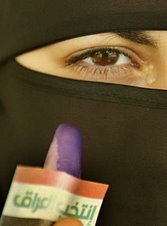
Gender equality in Iraq

Police recruit, Karbala, Iraq

Poppy culture: Update on opium

From the 2009 "Afghan Opium Survey", the annual report produced by the UN Office on Drugs and Crime:

  • Poppy cultivation declined 22 percent from May 2008 to June 2009 from 477 acres to 304 acres (or if you prefer your statistics in hectares - from 193,000 hectares to 123,000). 
  • 20 out of 34 provinces are now poppy free.
How to explain the improvement?  Two words: military operations.  Here's a list of the damage they were able to do: 
  • 90 tons of the chemicals to produce heroin
  • 450 tons of poppy seeds
  • 50 tons of opium
  • 7 tons of morphine
  • 1.5 tons of heroin
  • 19 tons of hash
  • 27 laboratories

Monday, May 11, 2009

A Swat refugee's Sophies' choice

From today's Washington Post:

"When the shelling started, my wife and I ran out to gather the children. It was like a hell outside, and we just started running," recounted Taj Mahmad, 35, a vegetable-cart puller. "I realized that my son and my smallest daughter were missing. She is only 3. But my wife cried and said the rest of us would be killed if we stayed, so we kept going. I have no idea what happened to them."
I'm trying to be sympathetic to the pressure they must have been under but all I can think of is this couple has too many children. I mean, they didn't know where their 3-year-old was?

Sunday, May 10, 2009

What are we doing wrong in Afghanistan?

Spending too much money on security for Westerners for starters according to a report published by Truthout. The report also gives us an idea why we've been so clueless:

There have been numerous attacks on foreigners in Kabul and suicide bombings have been effective from the Taliban's point of view in driving almost all expatriates into well-defended compounds where living conditions may be luxurious but which are as confining as any prison. This means that many foreigners sent to Afghanistan to help rebuild the country and the state machinery seldom meet Afghans aside from their drivers and a few Afghans with whom they work.

Friday, April 17, 2009

Your favorite cartoonist profiled here


RAP21, which bills itself as the "African press network for the 21st century" profiled Abdul Arts, this blog's favorite cartoonist, the Somali exile who left his country because he couldn't live under the prevailing "shut your mouth, otherwise you will be killed" attitude.

Former colleagues have paid the price of staying. Mohamed Muhiaddin, his former editor at a Somali weekly, was blown up by extremists in late 2007. A former colleague, Said Tahil Ahmed, continued working as a journalist. He was gunned down in a public market. Mayow Hassan, a radio journalist was murdered on January 1.

Even in Egypt, Abdul Arts doesn't feel entirely safe. He routinely receives threatening emails everytime a cartoon is published. Nevertheless he carries on. "My goal is drawing these cartoons is to support the peace process and freedom of the press. I also use my cartoons to present the situation of my country, to show the people the crimes against the humanity, and the crisis in my country....Being a political cartoonist in my country and Africa is a dangerous career, because there isn't freedom of speech. But I am an ambitious person and I hope to continue my job as long as I can and never stop."


Tuesday, April 14, 2009

What peace under the Taliban looks like

From today's Wall Street Journal:

Thousands of Islamist militants are pouring into Pakistan's Swat Valley and setting up training camps here, quickly making it one of the main bases for Taliban fighters and raising their threat to the government in the wake of a controversial peace deal.

As the report continues:

Swat now offers a glimpse of the Taliban's vision for Pakistan. They have taken control of the local government and the police, who have been ordered to shed their uniforms in favor of the traditional Shalwar Kameez, an outfit comprising a long shirt and loose trousers. They also have seized Swat's emerald mines, which extract millions of dollars a year in gemstones.
At barbershops, notices warn men not to shave their beards. Women are no longer allowed to leave their homes without their husbands or male blood relatives. Girls' schools have been reopened after initially being closed but the students must be covered from head to toe, and Taliban officials routinely inspect classrooms for violators.
The Taliban's spokesman told the WSJ that the Taliban was planning to start executing a list of people soon for "un-Islamic" activities:
The list includes senior government officials, a woman whose husband is in the U.S. military, and others. Many of them have fled or are in areas outside Taliban control
"These kinds of people should not live," said Mr. Khan, who also is a commander in the Tehrik-e-Taliban, a broader Taliban alliance focused on battling the Pakistani government.
..."It does not matter to us whether the peace deal stays or not. No one can stop us from setting up our own courts," he said.
To see how Taliban justice works, check out the video below that aired on television stations in Pakistan recently. In the video, a woman is shown being caned for the crime of having left her house unaccompanied by her male guardian.

As the WSJ reported, while the Taliban spokesman insisted the video was fake, he did acknowledge that the flogging incident depicted did in fact occur. "As a Muslim, we cannot allow a woman to violate Islamic values," he said.
Taliban Punishment of Young Girl2:27.

The Taliban in Punjab

Me, Sharon Chadha, sister-in-law of Punjab, doing some of my own
research at the source of the Taliban movement (Darul Uloom Deoband in India).

Photo: Courtesy of the NY Times

Today's New York Times reports:
Taliban insurgents are teaming up with local militant groups to make inroads in Punjab....
“I don’t think a lot of people understand the gravity of the issue,” said a senior police official in Punjab, who declined to be idenfitied because he was discussing threats to the state. “If you want to destabilize Pakistan, you have to destabilize Punjab.”
As the report continues:

In at least five towns in southern and western Punjab, including the midsize hub of Multan, barber shops, music stores and Internet cafes offensive to the militants’ strict interpretation of Islam have received threats. Traditional ceremonies that include drumming and dancing have been halted in some areas.
Bhanghra? Can the Taliban really be thinking they will be able to permanently ban Bhangra in Punjab???????? This I cannot believe for a second.

For those of you unfamiliar with Bhangra, it is the traditional music of Punjab. Everywhere you find Punjabis you find Bhangra. And everywhere you find anyone who has ever had a friend who is Punjabi too. Bhangra has now spread to clubs and on radio stations across Europe and North America.

Now I can imagine the Taliban finding recruits among Punjab's poor and ignorant youth. But having experienced Punjabis now for longer than I'm willing to admit here - I am married to a Punjabi -I cannot conceive of their elders or even their more serious peers ever going down this path, not even for a second. I say this is because Punjabis have to be dominant. With all due love and respect to my in-laws and darling husband, all of whom I worship, Punjabis never ever cede control, not for one minute, not even to me!

And the Times report seems to bear me out:

The Taliban here exploit many of the same weaknesses that have allowed them to expand in other areas: an absent or intimidated police force; a lack of attention from national and provincial leaders; a population steadily cowed by threats, or won over by hard-line mullahs who usurp authority by playing on government neglect and poverty.

...Locals feel helpless. When a 15-year-old boy vanished from a madrasa in a village near here recently — his classmates said to go on jihad — his uncle could not afford to go look for him, let alone confront the powerful men who run the madrasa. “We are simple people,” the man said. “What can we do?”

My conclusion: If there is any intelligent element to be found among the Punjabis who are aligning with the Taliban, it is those Punjabis who are using the Taliban as the means to their own end. That is, they are using the Taliban, just as their fellow Punjabis have used the Taliban all along.
This is not just Punjabi in-law pride on my part either. Consider the evidence. In one sentence: It is the Punjabis in the Pakistani ISI and army who created the Taliban, have made money off the Taliban via US and foreign aid, but it is the Taliban who have taken all the losses.

The Taliban might well find love and happiness among the Punjabis (as I certainly have) but if they are thinking they will ever dominate them - nope, not a chance. They will not be able to stop the Bhangra parties in Punjab. Never ever. You can't even get them to turn the Bhangra down.

Monday, April 13, 2009

Another image of Somalia

Photo courtesy of Abdul Arts.

Afghanistan should be having the same debate Mexico is - and so should the US

The Washington Post reports:


Mexico's Congress opened a three-day debate Monday on the merits of legalizing marijuana for personal use, a policy backed by three former Latin American presidents who warned that a crackdown on drug cartels is not working.

... three former presidents _ Cesar Gaviria of Colombia, Ernesto Zedillo of Mexico and Fernando Cardoso of Brazil _ urged Latin American countries to consider legalizing the drug to undermine a major source of income for cartels.

As as another article in the Post reported California is also considering legislation to legalize marijuana:
...in California, pot is such a booming growth industry that lawmakers are being asked to consider its potential as a salve to the state's financial woes. Betty Yee, chairman of the California State Board of Equalization, citing the state's budget problems. California currently collects $18 million in sales taxes from marijuana dispensaries, and [chairman of the California State Board of Equalization Betty] Yee said a regulated pot trade would bring in $1.3 billion.

Prohibition doesn't kill demand it only enriches the criminal class - and the insurgents in Afghanistan's case.

Saturday, April 11, 2009

The law suppressing women's revulsion in Afghanistan

When I first heard about Afghanistan's new law sanctioning rape in marriage my first thought was can Afghan men really be that desperate?

In Afghanistan, as you may recall, a man can legally have as many as four wives at a time. And in the event he grows tired of any one of them, divorce is shockingly easy. Given that the deck already seems to be stacked so much a man's favor, how bumbling can Afghan men be that they also need to have what goes on in their bedrooms legislated?

Ayatollah Mohseni, the leader of the Shia community who demanded this law, tries to explain. While he remained silent on the local seduction techniques, he did suggest that the law arose out of the extreme gender inequality that prevails in the country. Due to the widespread illiteracy among Afghan women, and their lack of work opportunity (it doesn't help that they cannot leave the house without their husband's permission) a woman cannot be asked to pull her weight financially. As he poses the problem: "For all these expenses can't we at least give the right to a husband to demand sex from his wife after four nights?" (AP).

Maybe they wouldn't have to rape their wives if they freed them.

Sunday, April 5, 2009

Fareed Zakaria: Allow radical Islam to defeat itself

In the latest issue of Newsweek, Fareed concedes that radicals like the Taliban are "ugly, reactionary forces that will stunt their countries and bring dishonor to their religion." But as he since "not all these Islamists advocate global jihad, host terrorists or launch operations against the outside world" we need to stop fighting these elements as we are only widening our war against terror (I know, we're not supposed to use that expression any longer but old habits die hard so indulge me for a moment):

We have placed ourselves in armed opposition to Muslim fundamentalists stretching from North Africa to Indonesia, which has made this whole enterprise feel very much like a clash of civilizations, and a violent one at that. Certainly, many local despots would prefer to enlist the American armed forces to defeat their enemies, some of whom may be jihadists but others may not. Across the entire North African region, the United States and other Western powers are supporting secular autocrats who claim to be battling Islamist opposition forces. In return, those rulers have done little to advance genuine reform, state building or political openness. In Algeria, after the Islamists won an election in 1992, the military staged a coup, the Islamists were banned and a long civil war ensued in which 200,000 people died. The opposition has since become more militant, and where once it had no global interests, some elements are now aligned with Al Qaeda.
As he goes on to say:
Bin Laden constantly argues that all these different groups are part of the same global movement. We should not play into his hands, and emphasize instead that many of these forces are local, have specific grievances and don't have much in common.
David Kilcullen, a counterinsurgency expert who has contributed to the success of Gen. David Petraeus in Iraq, seems to agree with him:
"I've had tribal leaders and Afghan government officials at the province and district level tell me that 90 percent of the people we call the Taliban are actually tribal fighters or Pashtun nationalists or people pursuing their own agendas. Less than 10 percent are ideologically aligned with the Quetta Shura [Mullah Omar's leadership group] or Al Qaeda." These people are, in his view, "almost certainly reconcilable under some circumstances." Kilcullen adds, "That's very much what we did in Iraq. We negotiated with 90 percent of the people we were fighting."
So it seems does CIA analyst Reuel Marc Gerecht: "What you have to realize is that the objective is to defeat bin Ladenism, and you have to start the evolution. Moderate Muslims are not the answer. Shiite clerics and Sunni fundamentalists are our salvation from future 9/11s."

And for what it is worth, I think he is on to something too:
The veil is not the same as the suicide belt. We can better pursue our values if we recognize the local and cultural context, and appreciate that people want to find their own balance between freedom and order, liberty and license. In the end, time is on our side. Bin Ladenism has already lost ground in almost every Muslim country. Radical Islam will follow the same path. Wherever it is tried—in Afghanistan, in Iraq, in parts of Nigeria and Pakistan—people weary of its charms very quickly. The truth is that all Islamists, violent or not, lack answers to the problems of the modern world. They do not have a world view that can satisfy the aspirations of modern men and women. We do. That's the most powerful weapon of all.

Saturday, April 4, 2009

The audacity of hope

Or is it the audacity of asking NATO for more troops?

The (London) Times reports that only Britain offered "substantial help" in response to President's Obama's "impassioned plea" to send troops to Afghanistan or risk terror attacks in Europe.

Britain offered to send several hundred more British soldiers - but only to provide additional security for the August presidential elections - and not the thousands of extra troops the American president was hoping Britain would commit. Update: The NY Times reports that Britain is pledging 900 and Germany and Spain have agreed to each send 600 soldiers to provide security for the August elections.

The only other two "allies" that made firm committments were Belgium and Spain. Both pledged to send military trainers - 35 from Belgium and 12 from Spain.

Contrast these numbers with the 21,000 more troops President Obama has pledged (with a promise to send an additional 9,000).

“Europe should not simply expect the United States to shoulder that burden alone,” he said. “This is a joint problem it requires a joint effort.”

He said that failing to support the US surge would leave Europe open to a fresh terrorist offensive. “It is probably more likely that al-Qaeda would be able to launch a serious terrorist attack on Europe than on the United States because of proximity,” he said.

President Sarkozy stated that he would not send any more French troops. Germany, Italy, Poland, and Denmark reportedly were still considering the request.

Afghanistan for its part offered the European nations a perfect way out. As Jaap de Hoop Scheffer, the Nato Secretary-General, pointed out, new laws sanctioning child marriage and marital rape soured the mission.

“We are there to defend universal values and when I see, at the moment, a law threatening to come into effect which fundamentally violates women’s rights and human rights, that worries me,” he was reported as saying. “I have a problem to explain to a critical public audience in Europe, be it the UK or elsewhere, why I’m sending the guys to the Hindu Kush.”

So while Karzai may have won some support among the Afghan public because of these new laws - said to have been enacted to appease the Shia community - he lost most of whatever support he had in Europe.

Friday, April 3, 2009

And hear what Stephen Walt has to say even if you can't bear his position on The Lobby

From his blog at Foreign Policy

Our efforts in Central Asia are confounded by two fundamental problems. First, our understanding of Pakistani and Afghan society is limited, which makes it hard to know which groups or leaders to support and makes it virtually certain that any effort we undertake will generate lots of unintended consequences. We were once confident that Hamid Karzai would be a terrific leader, for example, but he's proven to be a disappointment. If we try to engineer his replacement, however, there's no guarantee we will end up with anyone better. Ditto Pakistan, where none of the contenders for power looks particularly promising and where their own ambitions and interests are partly (and maybe substantially) at odds with ours.

Look at this way: We have enough trouble getting reliable, efficient, and corruption-free government here at home (think Rod Blagoevich, Jack Abramoff, or the State Legislature here in Massachusetts, where the past two speakers had to resign in the face of scandals).. . . To imagine that we know how to manage the politics of more than 200 million people in Afghanistan and Pakistan -- who are themselves divided into a diverse array of clans, tribes, and sects -- is the very definition of hubris.

Second, our leverage in either society (and especially Pakistan) is limited by our own conviction that "we cannot afford to fail." If we are unwilling to walk away and leave either country to its fate, then President Obama's assurance that "we will not, and cannot, provide a blank check" is meaningless. Former Pakistani President Pervez Musharraf diddled us for years because he knew we were so committed to his success that we would keep pouring in money even when we knew his government was still backing jihadi terrorists instead of cracking down on them.

If, like AIG, Pakistan is "too important to fail," then what’s going to be different now? Which brings me to the larger question: What is the strategic rationale for doubling down in Afghanistan and Pakistan? According to President Obama, the reason we are there is simple: We want to prevent these territories from becoming safe havens for terrorists who might attack the United States....

...while it is obvious that al Qaeda is a threat, is it of sufficient magnitude to warrant an expensive and possibly open-ended effort to re-shape the politics of this region? Although Obama denies that this is his goal, how do we "defeat al Qaeda" without doing a lot of social engineering in both places?

Will wonders never cease?

I have to say, I find myself nodding in agreement as I read Juan Cole's post at Informed Comment:

An Afghan army foot patrol was attacked by guerrillas in Helmand Province on Wednesday, according to AP. US and Afghan soldiers responded, engaging in a firefight. Then the US military called in an air strike on the Taliban, killing 20 of them. On Tuesday, a similar airstrike had taken out 30 guerrillas.It is this sort of thing that makes me wonder why the Taliban (or whoever these guys in Helmand were) are considered such a big threat that the full might of NATO is needed to deal with them. They have no air force, no artillery, no tanks. They are just small bands, apparently operating in platoons, who, whenever they mass in large enough numbers to stand and fight, can just be turned into red mist from the air.
And here too:

Now thousands of private security contractors (i.e. mercenaries) will be hired in Afghanistan. But they won't be Americans for the most part. Children, can you say "Hessians"?

I don't understand the concept of paying someone $200,000 a year to guard armed GIs being paid a fraction of that. Wouldn't it be better to expand the size of the army if you need more troops? Wouldn't it be more efficient to have one line of command? Aren't these essentially high-priced MPs?

Check out what's not happening on the sun


Tracking what's not happening on the sun might be even more important than what humans are doing here on earth. Begin with this article at NASA: Deep Solar Minimum. Then check around for possible scenarios.

Europe's version of shoe throwers

See them on a NYT slide show: Protestors Fail to Bring Down Global Capitalism With Costumes and Puppets.

What could the Pentagon be thinking (or is it smoking)?

The NY Times is reporting that the Pentagon is proposing that Americans cough up another $3 billion for Pakistan, as if they have been helpful in stabilizing Afghanistan and countering militancy at home.

As the Times notes:

The United States has [already] provided Pakistan with more than $12 billion in military and economic assistance since the Sept. 11, 2001, attacks, including about $1 billion a year to reimburse Pakistan for fielding 100,000 forces along its border with Afghanistan. American lawmakers have complained that much of that money has disappeared into Pakistani government coffers with scant accountability and little progress to show.

Adm. Mike Mullen, the chairman of the Joint Chiefs of Staff, acknowledged Thursday that the United States had not imposed sufficient accountability measures on the money. “There hasn’t been an audit trail, and there haven’t been accountability measures put in place, and there needs to be for all the funds,” Admiral Mullen said in an interview with the editorial board of The New York Times. “So we’re going to do that. For this counterinsurgency money, which is important, it is critical that it goes for exactly that and nowhere else.”

...Insurgents and terrorists operating in Pakistani safe havens are plotting attacks against targets in both Afghanistan and Pakistan, the admiral said. “The Taliban, in particular, are going both ways now,” he explained. “They are coming toward Islamabad and they are actually going toward Kabul."


As unbelievable as this may seem, Admiral Mullen still apparently hopes that he can count on support from Islamabad. As he told the Times reporter, "I’m completely convinced that the vast majority of the leaders in Pakistan understand the seriousness of the threat.”

Really. Is he smoking opium or what?

NATO: Faking a military alliance

From the NY Times:

[President Obama's] NATO allies are giving the president considerable vocal support for the newly integrated strategy. But they are giving him very few new troops on the ground, underlining the fundamental strains in the alliance.

The allies will offer more funds but no more than several thousand new personnel members, according to alliance military planners. Many of those will not be soldiers, but police trainers to meet a central pillar of the president’s new Afghan strategy, which focuses on an expansion of Afghan security forces.

But even for the small numbers of European combat reinforcements, check the fine print: Nearly all will be sent to provide security for Afghanistan’s elections this summer, and will not be permanent.

As the Times report duly notes, it does not really matter who the American president is either:

“As a candidate, Obama had expectations that Europe would make a serious increase in troop levels after he became president,” said Charles A. Kupchan of the Council on Foreign Relations in Washington. “But there is a realization now that Europe’s main contribution will be police trainers, economic assistance and development assistance.”

...In many cases, European capitals have placed severe restrictions on their forces assigned to NATO’s International Security Assistance Force, or I.S.A.F. That has been such a hindrance to the war effort, in the view of some American commanders, that they ruefully say the alliance mission’s initials now stand for “I Saw America Fight.”

To be sure, a number of NATO and other partner nations have sent troops to Afghanistan who have fought and died in percentages larger than those of the American military. Australian, British, Canadian, Dutch and French conventional forces have shed much blood, and commando units from some of the smaller, newer NATO allies in the Baltics have punched far above their weight, according to American Special Operations commanders.

Wednesday, April 1, 2009

Tuesday, March 31, 2009

How to win votes in Afghanistan

The London Guardian reports:

Hamid Karzai has been accused of trying to win votes in Afghanistan's presidential election by backing a law the UN says legalises rape within marriage and bans wives from stepping outside their homes without their husbands' permission.

Oddly, it is not the usual suspects who wanted this legislation:
A western diplomat said the law represented a "big tick in the box" for the powerful council of Shia clerics. Leaders of the Hazara minority, which is regarded as the most important bloc of swing voters in the election, also demanded the new law.

Ok Hazara, justify this.

Ustad Mohammad Akbari, an MP and the leader of a Hazara political party, said the president had supported the law in order to curry favour among the Hazaras.

But he said the law actually protected women's rights."Men and women have equal rights under Islam but there are differences in the way men and women are created. Men are stronger and women are a little bit weaker; even in the west you do not see women working as firefighters."

Akbari said the law gave a woman the right to refuse sexual intercourse with her husband if she was unwell or had another reasonable "excuse". And he said a woman would not be obliged to remain in her house if an emergency forced her to leave without permission.


And women legislators? How did they rationalize the law they just passed?
"Some female politicians have taken a more pragmatic stance, saying their fight in parliament's lower house succeeded in improving the law, including raising the original proposed marriage age of girls from nine to 16 and removing completely provisions for temporary marriages.

"It's not really 100% perfect, but compared to the earlier drafts it's a huge improvement," said Shukria Barakzai, an MP. "Before this was passed family issues were decided by customary law, so this is a big improvement."

And the West spending all that blood and treasure to right things in Afghanistan, what was their reaction to this, um, step backward?

The international community has so far shied away from publicly questioning such a politically sensitive issue.

"It is going to be tricky to change because it gets us into territory of being accused of not respecting Afghan culture, which is always difficult," a western diplomat in Kabul admitted.


Here's my suggestion on how this law can be applied to protect women. Let he who fails to comply with God's law to treat his wife in a decent, moral and merciful way be declared an apostate and punished according to Islamic law. (That is, put him to death.)

Allow husbands to lord over wives if you must but only in compliance with Islam. Then it can be reasonably argued that this law does in fact protect women. Otherwise, not.

Primer on Pakistan

Here's the Idiot's Guide Pakistan to help you decipher the situation in Pakistan.

Monday, March 30, 2009

Tom Ricks wasn't impressed

Here is what former Washington Post reporter Tom Ricks (and author of Fiasco and The Gamble - and someone who is always worth reading) said about the new Afghan-Pak strategy:

I liked President Obama's Afghan stuff, as far as it went. Reducing American goals and training Afghan security forces makes sense. And reaching out to less extreme Taliban leaders is also worth trying. But I was surprised by how little the president had to offer on the other big problems. Sure, corruption in Afghanistan is easy to denounce, Mr. President, but what are you going to do about it? How are you going to stop the police from shaking down Afghans and so driving them into arms of the Taliban?

Finally, what about the Pakistani military? The saying is that most countries have militaries, while in Pakistan the military has a country.

Right now the Pakistani armed forces are part of the problem. Obama gave no indication of how they might be made part of the solution, and that worries me. I know it is difficult to say anything about this publicly -- but he should have said something.

Comments on Obama's new Afghan-Pak strategy

Here's some reportage from Laura Rozen at Foreign Policy's The Cable on what various people are saying about the new strategy. Her blog is always worth checking out, incidentally, if you're interested in the ins and outs of US foreign policy.

Obama's plan

Here's the link to the Obama administration's strategy for Afghanistan and Pakistan. And here is what the White House posted as a one-page summary of the plan's salient features:


What’s New in the Strategy for Afghanistan and Pakistan

"As President, my greatest responsibility is to protect the American people…We are in Afghanistan to confront a common enemy that threatens the United States, our friends and allies, and the people of Afghanistan and Pakistan who have suffered the most at the hands of violent extremists. So I want the American people to understand that we have a clear and focused goal: to disrupt, dismantle, and defeat al Qaeda in Pakistan and Afghanistan, and to prevent their return to either country in the future…To achieve our goals, we need a stronger, smarter and comprehensive strategy." President Barack Obama, March 27, 2009

An Attainable Objective

On March 27, 2009, the President announced a comprehensive, new strategy for Afghanistan and Pakistan that is the culmination of a careful 60-day, interagency strategic review. During the review process, we consulted with the Afghan and Pakistani governments, partners and NATO allies, other donors, international organizations and members of Congress.

The strategy starts with a clear, concise, attainable goal: disrupt, dismantle, and defeat al Qaeda and its safe havens. The President’s new approach will be flexible and adoptive and include frequent evaluations of the progress being made. A Regional ApproachFor the first time the President will treat Afghanistan and Pakistan as two countries but one challenge. Our strategy focuses more intensively on Pakistan than in the past, calling for more significant increases in U.S. and international support, both economic and military, linked to Pakistani performance against terror. We will pursue intensive regional diplomacy involving all key players in South Asia and engage both countries in a new trilateral framework at the highest levels. Together in this trilateral format, we will work to enhance intelligence sharing and military cooperation along the border and address common issues like trade, energy, and economic development.


Building Capacity and More Training

For three years, the resources that our commanders need for training have been denied because of the war in Iraq. Now, this will change. The 17,000 additional troops that the President decided in February to deploy have already increased our training capacity. Later this spring we will deploy approximately 4,000 more U.S. troops to train the Afghan National Security Forces so that they can increasingly take responsibility for the security of the Afghan people.

In the President’s strategy, for the first time we will fully resource our effort
to train and support the Afghan National Army and Afghan National Police. Every American unit in Afghanistan will be partnered with an Afghan unit, and we will
seek additional trainers from our NATO allies to ensure that every Afghan unit has a coalition partner.

Using All Elements of National Power

As the President said, a "campaign against extremism will not succeed with bullets or bombs alone." As a part of this strategy, we will devote significantly more resources to the civilian efforts in both Afghanistan and Pakistan. The President will submit a budget that includes indispensable investments in our State Department and foreign assistance programs. These investments relieve the burden on our troops and contribute directly to our safety and security. The Administration consulted with the Congress during our review and is committed to working closely together to provide the resources needed to carry out the strategy. The President supports the bipartisan bill co-sponsored by Senators Kerry and Lugar to authorize $1.5 billion a year in direct support to the Pakistani people over the next five years. He also calls on Congress to pass the bipartisan bill creating Reconstruction Opportunity Zones in Afghanistan and the border regions of Pakistan to develop the economy and bring hope to places plagued by violence.

Bringing new international elements to the effort

The President believes we need to provide more resources for the civilian aspects of the mission, working with the Afghan Government and all of our partners in NATO and the United Nations. As America does more, we will ask others to do join us in doing their part. Together with the United Nations, the Administration will forge a new Contact Group for Afghanistan and Pakistan that brings together all who should have a stake in the security of the region – our NATO allies and other partners, the Central Asian states, Gulf nations, Iran, Russia, India and China. All have a stake in the promise of lasting peace and security and development in the region.

Friday, March 20, 2009

Financing Afghanistan

According to yesterday's New York Times, President Obama is about to approve a plan that would double the number of Afghan security forces - to three times the number projected in 2002. According to the report, "even members of Mr. Obama's security team appeared taken back by the cost of the program."

The program, the Times reports, will cost up to $20 billion over seven years. Already the government in Kabul depends on the international community's largesse and the new costs are more than twice the budget of the entire government.

Nevertheless, this is a cost that it appears we will have to pay if we are interested in winning this fight. NATO, as a recent Times editorial put it, is "frighteningly close to failing" in Afghanistan.

And it is not because of the usual suspects - the terrorism, corruption and weak central government, to paraphrase the Times - that the alliance is confronting in Afghanistan. NATO is being undone by its own fecklessness. Members are compelled to come to the defense of any fellow state who is attacked - such as the U.S. was on 9/11 - but they can do so in whatever way they deem acceptable.

Germany, for example, refuses to allow its soldiers to engage in combat missions. Other nations won't eradicate opium though they acknowledge that it is now the Taliban's main revenue stream. The only states of the 26 members who have proved themselves to be mostly reliable when it comes to heavy lifting are the US, Britain, Canada, the Netherlands, and Denmark.
And no surprise to find out that many of the same NATO members that are loathe to bloody their hands are just as loathe to foot a larger bill. This, they are suggesting, is where the oil rich monarchies should come in.

While they should indeed -Al Qaeda and the Taliban love the Persian Gulf countries no more than they love the Western democracies, given all the demands about reducing carbon consumption - the source of their wealth, one wonders how eager they will be to help. Hoist yourself on your own methane gas, one can imagine them saying when Europe comes begging for Afghan alms.

Perhaps a better idea would be to let Afghanistan fund the cost. They could easily do this if they would only legalize the opium industry. Think of all the goals we could accomplish with this one step.

We could cut off the Taliban's funds, disenfranchise the criminal class, put profits in the hands of law-abiding and pro-democracy Afghans, create a tax base for the government and take Afghanistan off the international dole.

Pretending for a moment that we could even fund this new program, why lose both the War on Drugs and the War on Terror?

Tuesday, March 17, 2009

And on the opium front

The New York Times reports:

A suicide bomber on foot struck a police convoy about to head out on a poppy eradication mission in southern Afghanistan on Monday morning, killing 11 people and wounding 28, the police said...

Dawood Ahmadi, a spokesman for the governor of Helmand, said the success of recent efforts by security forces to destroy opium-poppy fields had prompted the attack on thecounternarcotics convoy, which was in the provincial capital, Lashkar Gah. “This was a work by Taliban and drug smugglers,” he said...


Apparently there have been many such attacks on these roads lately suggesting that the Taliban and their narcotrafficking enablers can take out whoever they want to on these roads but the ISAF and the Afghan security forces cannot take out the opium smugglers and insurgents who use the same highway.

I get why it's hard to intercept suicide attackers - who can tell what an individual is about to do? It's a logistical problem. What I don't get is why it is so hard to intercept the drug smugglers and insurgents who transit these same roads.

And I don't get why the eradication program focuses on eliminating the poppy crop itself. This only hurts the farmers who are largely subsistence and in many cases forced to grow.

Why don't they focus on the traffickers? Or at least legalize opium and then collect the taxes so Afghanistan will at least have some revenue base. Let the demand chain worry about the consequences for a change.

Pakistan: "We're watching history"

Thus spoke Javed Ali Khan, a Pakistani man who as the New York Times reports:

...traveled for days with his wife and six children to participate in a national march of lawyers and opposition political parties that came to an abrupt end on Monday when the lawyers demands were met....

“Justice,” said Mr. Khan’s wife, Rubina Javed, smiling broadly. “We came for justice...Justice is the solution to the common man’s problems,” Ms. Javed said, seated on a blue scarf on the grass with two daughters and four sons, ages 6 to 18, around her. “I want justice in schools, on roads, in transportation. Now the common man is speaking.”


As the Times report continued:

[In] Pakistan, the political class comes from a powerful feudal elite, which has largely avoided policies that would bring greater social equality, like land reform. With only half of the population literate, so far the strategy has worked.

“The ruling elite can get away with anything,” said Muhammad Ali, a software engineer. “They are like kings here.”

But the lawyers’ movement may be starting to change that. Though small in number, it is made up of an educated, diverse cross section of Pakistani society that includes lower middle
class professionals, whose reach may extend deeper into Pakistan’s 160 million population than initially expected.

“This movement has given an awareness to the common people in Pakistan of their rights,” said Shamoon Azhar, 26, a doctoral student at the International Islamic University in Islamabad, sitting on the lawn with a large group of his friends. “This is about awareness. It’s given people confidence. It’s shown people it can happen.”...


“The feudal system, it was in the past,” said Mazhar Iqbal, a private school manager. “There was no media then. No education. The poor were poor forever. Now is the time to wake up. It’s been 60 years and we’ve been wasting our time.”

Saif Abbas, a consultant who used to work for the Asian Development Bank in Islamabad, was more clear-eyed about the meaning of the march. Pakistan is still a poor country with a vast illiterate population, and a corrupt, unresponsive ruling class, he said.

“This country has to take control of its own future, and that’s education,” he said, holding a flag. “Unfortunately, we’re just not there yet.”

His vision for Pakistan is a “thoroughly democratic” country based on an Islamic system of governance, with a strong, powerful middle class, like that in Turkey or Malaysia. The current system will simply perpetuate the power of the mullahs on one hand, he said, and the elite, on the other, “who are totally disconnected from the people of this country.”

Sunday, March 15, 2009

Cvilian versus a military regime in Pakistan

The New York Times reports on the clash that erupted today when members of the lawyers' movement and supporters of Nawaz Sharif, "the opposition leader" tried to stage a protest in Lahore.

[There is only one opposition leader in a country of _____ million????]

According to the Times, the police fired tear gas at the protestors, even bringing in armored vehicles to avoid being hit by the stones the protestors were hurling back at them. When the protestors started burning tires, the police chased them with batons.

This type of government crackdown on protests, according to the Times report, was unheard of during the eight-year military rule of President Musharraf. In fact, it was so weird that Sajjad Bhutta, Lahore's chief magistrate, told the Times that he refused to carry out what he perceived was an illegal police crackdown.

As the Times noted:

The current battle between Mr. Zardari and Mr. Sharif, a former prime minister, began on Feb. 25 when the president imposed executive rule on the Punjab Legislature, the stronghold of Mr. Sharif’s party.

Hours earlier, the Supreme Court had issued its ruling disqualifying the Sharifs from holding office. To consolidate their opposition to Mr. Zardari, the brothers joined forces with the lawyers’ movement, which had called for a national protest and sit-in in Islamabad on March 16.
...
But as Mr. Zardari, the widower of Ms. Bhutto, stood firm, senior members of his party began to desert him. The minister of information, Sherry Rehman, resigned late Friday night after a prominent television news channel, Geo, was banned by the government in some parts of the country. Another senior official, Raza Rabbani, who was the party leader in the Senate, resigned from the cabinet after Mr. Zardari bypassed Mr. Rabbani and chose a more junior lawmaker, Farooq H. Naik, for the most senior post in the Senate chamber.

Saturday, March 14, 2009

Sarah Chayes rethinks opium eradication

A gem from her Afghanistan Policy Action Plan:

Rethinking eradication. In line with new authorities agreed upon by NATO, interdiction efforts should be aimed not at growers, but at traffickers and profiteers, even when they hold government positions. A few patient and determined well-placed ambushes on roads linking Urozgan and Kandahar Provinces, for example, could net several thousand kilos of opium paste in a single month.

The audacity of the plan to reconcile the Taliban

The New York Times reported that the Obama administration has concluded that "most of the foot soldiers in Afghanistan and Pakistan are 'reconcilable' and can be pried away from the hard-core organizations of the Taliban and Al Qaeda."

The administration even has a figure in mind, according to "administration officials" says the Times, of "at least 70 percent of the insurgents and possibly more."

Now what does reconcilable mean you ask? Those that "can be encouraged to lay down their arms with the proper incentives." [The emphasis is mine.]

And what might proper incentives be? Charter schools for girls? Sub-prime mortgages for those whose houses have been bombed? National health care to replace missing limbs? Government funding so budding Taliban stem-cell researchers can eventually compete in the real world?

Apparently not. According to the Times, the Obama plan to reconcile the Taliban calls for a continuation of the CIA-orchestrated drone attacks inside Pakistan; and an increase in military and financial aid to Pakistan - with strings, however, says the Times.

Pakistan would have to spend the money "more on counterinsurgency and less on its long-running feud with India," according to the unnamed senior administration official the Times spoke to.

This condition should be easy enough for Pakistan to accept. How much can attacks like the ones in Mumbai last November cost?

As far as how much the Obama administration is thinking of giving Pakistan, if the legislation that Mr. Obama and Mr. Biden sponsored when they were both still senators is any indication, Pakistan might well get triple the nonmilitary aid it got under the Bush administration.

Now it may rankle some that the Pakistanis would get even more aid but the benefits of their hoping they will appear to be already paying off. Since the Times report does not explicitly connect the dots, I will. Here is the salient dot:

...in carrying out missile strikes, the C.I.A. has steadily developed its own network of sources in the tribal areas, and combined with improved information-sharing with Pakistan’s main intelligence agency in recent months, as well as some technical advances like installing more mobile towers to intercept cellphone calls, the agency has been getting much better intelligence on its drone targets than it did just a few months ago, officials said.

Now what kind of numbers are they throwing around here? Oh just another $1 billion a year for Pakistan - not including whatever military aid, they get, the cost of the added cellphone towers, and the CIA only knows what else. It's a nice business Pakistan has carved out for itself out of Afghanistan's misery.

Tuesday, March 10, 2009

If there's still honor among the Mamoond tribe, this could be great news

The New York Times reports that yesterday the Mamoond tribe struck a deal with Islamabad. The tribe has agreed to lay down their arms; cease harboring militants; and stop training militants. The tribe runs the Taliban in the Bajaur Agency. The tribe is also believed to have provided refuge for Al Qaeda members.

Among the senior Taliban leaders the tribe has agreed to surrender are senior commander, Maulvi Faqir Muhammad and spokesman, Maulvi Said Muhammad, otherwise known as Maulvi Omar.

If the Mamoond tribe has any honor, then Maj. Gen. Tariq Khan, Pakistani commander in the area, is absolutely right in saying, "It's the peoples' victory."

Monday, March 9, 2009

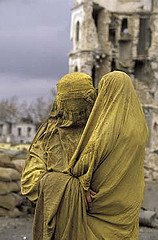
Displaced by the Taliban

Photo courtesy by Emilio Morenatti, Associated Press
Contrast the image above with the photos below of women in areas where they are no longer running from the Taliban. Notice any difference?

Pakistan's "victory" in Bajaur

The New York Times reports:

After a six-month campaign, the Pakistani military is claiming victory over the Taliban in Bajaur, a northern sliver of the tribal areas, saying the militants have suffered heavy losses and have been pushed over the border into Afghanistan.
Unfortunately, as the Times duly notes, the Pakistanis are alone in their assessment:

Residents and Western military experts, speaking on condition of anonymity because of the delicacy of the political situation, said it was likely that rather than being finally uprooted from this slice of Bajaur and a nearby stronghold in Loe Sam, the bulk of the Taliban forces had retreated to mountain enclaves, waiting to return, as they have so often, when the military eases off.


Idrees Khan, a tribal elder from the area, told the Times why he is reluctant to return to home:

He left with bad feelings and remains bitter, he said. The family tried under tremendous odds to stave off the Taliban in December, he said. When the militants attacked one of their houses near the market and his brother called for help, the army showed up late and was of little help, he said. A helicopter gunship came after the Taliban had fled, but it shot at the family house anyway, severely damaging it, he said.

His experience is apparently not unique, either:

Several residents of Inayat Kalay said they were nervous about security because they had tried to raise a volunteer army against the Taliban last fall, but had received inadequate backing from the authorities.
...He said he was reluctant to return, in part because he had no confidence in the Pakistani government. “When we returned in November they shelled us,” he said. “We don’t want to repeat that.”


The Pakistani military claims that some 1,600 militants have been killed in the six-month campaign. However, as the Times report continues, neither residents or Western military official believe this claim as Pakistan has provided no real evidence.

Moreover, as Mr. Khan pointed out to the Times reporter, the Taliban in the area seem to have come through the government's assault relatively unscathed. The main compound of Fakir Mohammed, the Taliban's main man in Bajaur, remains standing amid the rubble of everyone else's property. “Why don’t they hit his house?” as Mr. Khan inquired of the reporter.

Sunday, March 8, 2009

Audacity of hope: Praying for peace in Afghanistan


Photos courtesy of UNAMA

International Women's Day, Afghanistan

Tuesday, March 3, 2009

Change in Saudi Arabia

From today's  NYTimes.com :

Ever since King Abdullah announced a sweeping cabinet reshuffle two weeks ago, Saudi liberals have been in a rare holiday mood. Many have hailed the changes — including the replacement of some major conservative figures and the appointment of the first female deputy minister — as a “mini-revolution” and proof that the king is at last willing to tame this country’s hard-line religious establishment.

While not everyone is happy with the changes, as the Times duly notes, let's focus on those who were happy:

“The king’s message is that he is bringing new blood — legal, not religious,” said Abdul Rahman al-Lahem, a reformist lawyer who has been jailed for his advocacy. “I am very optimistic.”

More generally, the reform agenda has drawn momentum from King Abdullah’s personal popularity and a growing public dissatisfaction with radical religious figures....

The radicals’ popularity began to wane in 2003, when a series of brutal terrorist attacks here killed Saudis as well as foreigners. At the same time, public anger at the intolerance of the cane-wielding religious police has grown, fueled by a younger generation that is more exposed to the outside world.

“The sacred image of these people was destroyed,” said Awadh Badi, a scholar at the King Faisal Center in Riyadh, the capital. “Before, even the state couldn’t touch them.”

As the Times goes on to report:

To many Saudis, the issue of extremism is less important than the fact that the schools are not providing enough math and science or the broader view of the world that their children need as the country struggles to diversify its economy and oil prices fall.

“Seventy-five percent of what my 13-year-old daughter studies is religion,” said Fawziah al-Bakr, a professor of education at King Saud University. “We are all in favor of religion, but we don’t have to make all our children into clerics.”

As far as the kingdom allowing elections to be held. 

“Without changing the cultural infrastructure here, there is no point in elections or anything of the kind,” said one ardently reformist member of Saudi Arabia’s appointed Shura Council, which advises the king, who spoke on the condition of anonymity. “The extremists here are well organized, but the liberals are not organized at all. They don’t have channels of communication with the people.”

Monday, March 2, 2009

Afghanistan's narcotics trade: Friends, foes and enablers

There is a curious story about the Afghan narcotics trade in yesterday's (London) Times Online:

The troops, from a 2,000-man taskforce based in Helmand, have pushed west into Farah province to choke the Taliban's supply lines, part of an American plan to contain what they perceive as British "failures" in southern Afghanistan.

Why are the Americans so obsessed with routing the Taliban in Helmand?  The report continues:

Major-General Mart de Kruif, Nato’s senior general in southern Afghanistan, said central Helmand was the Taliban’s top priority. “They see it as their heartland,” he said.
“And they are fighting hardest there because there is a clear nexus between the insurgency and the drugs trade, which they are fighting to protect.”

...Lieutenant-Colonel David Odom, of the US marines ground combat element, stationed in Farah, said the insurgents used the roads west of Helmand to move “weapons, drugs and poppy money” to and from Iran and Pakistan.

The flying drones that patrol the roads day and night have watched thousands gather at impromptu bazaars to trade guns and drugs, often within a few miles of their bases. Even the Americans do not have sufficient troops to stop them.

It's not so surprising to me that the British cannot or will not put enough troops on the ground in Afghanistan to stop this trade.  What puzzles me is why than the Pakistanis and Iranians aren't more involved in stopping this flow. I get the anti-American angle to their agenda but at what cost to their people?  This makes me wonder, cui bono from the narcotics trade in those countries?  Which officials exactly benefit from looking the other way?