traffic analysis

Monday, December 31, 2007

Sunday Telegraph's tribute to General Petraeus

The London newspaper named him as their Person of the Year:

...the reason for picking Petraeus is simple. Iraq, whatever the current crises in Afghanistan and Pakistan, remains the West's biggest foreign policy challenge of this decade, and if he can halt its slide into all-out anarchy, Gen Petraeus may save more than Iraqi lives.

A failed Iraq would not just be a second Vietnam, nor would it just be America's problem.

It would be a symbolic victory for al-Qaeda, a safe haven for jihadists to plot future September 11s and July 7s, and a battleground for a Shia-Sunni struggle that could draw in the entire Middle East. Our future peace and prosperity depend, in part, on fixing this mess. And, a year ago, few had much hope.

To appreciate the scale of the task Gen Petraeus took on, it is necessary to go back to February 22, 2006. Or, as Iraqis now refer to it, their own September 11. That was when Sunni-led terrorists from al-Qaeda blew up the Shia shrine in the city of Samarra, an act of provocation that finally achieved their goal of igniting sectarian civil war.

A year on, an estimated 34,000 people had been killed on either side - some of them members of the warring Sunni and Shia militias, but most innocents tortured and killed at random. US casualties continued to rise, too, but increasingly American troops became the bystanders in a religious conflict that many believed they could no longer tame.
As the Telegraph elaborates:
Top of the class of 1974 at West Point Military Academy and the holder of a PhD in international relations, he is the co author of the US military's manual on counter-insurgency, a "warrior monk" for whom the messy intrigues of asymmetric warfare hold more interest than the straightforward challenges of 2003's invasion.

Simply being the best and brightest soldier of his generation, however, would not be enough for Iraq in 2007, where a major part of the "surge" involves reconciling Iraq's warring political tribes...

"Petraeus has a rare combination of great geopolitical skills as well as tactical and military ones," says retired General Jack Keane, a fellow architect of the surge strategy. "He is good at working with ambassadors, with the Iraqi government, and he also knows how to cope with uncertainty and failure, which is what you get in an environment like Iraq."
Aspiring leaders should memorize what General Keane pointed out - that a leader needs to know "how to cope with uncertainty and failure" because that, in my opinion, is always the key differentiator between leaders and followers: Leaders find their way out of a mess, while followers are happy just to wallow or complain.

Now as the Telegraph duly acknowledges:
Things are far from perfect but, after four years in which events did nothing but get worse, the sight of a souk re-opening, or a Shia family being welcomed back home by their Sunni neighbours, has remarkable morale-boosting power.

Where once Iraqis saw the glass as virtually empty, now they can see a day when it might at least be half full.
And even if, as the Telegraph goes on to say, should in the end General Petraeus' accomplishment end up being a brief "hiatus in the collapse of Iraq" well, that wouldn't really diminish his achievement. As the Telegraph writes:
He has given another last chance to a country that had long since ceased to expect one. And for that, Gen Petraeus is Person of the Year.

Mullah Omar finally dumps one of his criminals

Mullah Omar is apparently waking up. The New York Times reports:

The Taliban leader, Mullah Muhammad Omar, has ordered his chief commander expelled from the movement for disobeying Taliban rules, a spokesman said in a statement over the weekend.
As the report went on:
Local news reports suggested that he and his men were giving the Taliban a bad name through their criminal behavior, including robbery and extortion.
Naturally Mr. Dadullah, as the Times refers to him, protests the allegations:
Mr. Dadullah denied that he had been expelled and said that reports of his dismissal were baseless. He said he continued to respect and obey Mullah Omar.

Sunday, December 30, 2007

I regret to inform you of the murder of cartoonist Abdul Art's brother

Mohamed Muhuyidin Ali, the official spokesman for the anti-Islamist mayor of Mogadishu, Mohamed Dhere, was killed in a bombing the government claims was the work of Islamist insurgents.

Prior to serving as the mayor's spokesman, Ali was the editor of an independent newspaper for some two decades. He leaves behind a wife and three children.

Ali's brother, Abdul Arts, as regular readers will know, is the Somali refugee who regularly submits cartoons to this blog, cartoons that lament the damage terrorists do to his beloved faith, Islam.

And now he must lament the damage they have done to his family.

May God give them strength - and mercy. I do find myself asking, where is God's mercy in all of this?

Tuesday, December 25, 2007

More Christmas cheer

And more heartwarming Christmas news, again from Iraq. This time the Associated Press reports:

Thousands of Iraqi Christians made their way to church through checkpoints and streets lined with blast walls, many drawing hope from a lull in violence to celebrate Christmas Mass in numbers unthinkable a year ago...

The pews were almost full—women toward the back and on the right side of the church, the men on the left—and still more people streamed in. Outside, police armed with automatic rifles manned a checkpoint at the corner of the narrow street, searching every passing car for possible bombs...

Cardinal Emmanuel III Delly, leader of the ancient Chaldean Catholic Church and Iraq's first cardinal, celebrated Mass before about 2,000 people in the Mar Eliya Church the eastern New Baghdad neighborhood of the capital.

"Iraq is a bouquet of flowers of different colors, each color represents a religion or ethnicity but all of them have the same scent," the 80-year-old Delly told the congregation.

Muslim clerics—both Sunni and Shiite—also attended the service in a sign of unity.

"May Iraq be safe every year, and may our Christian brothers be safe every year," Shiite cleric Hadi al-Jazail told AP Television News outside the church. "We came to celebrate with them and to reassure them."

Christmas message from Iraq

Via the NY Times. From Rev Thaer al-Sheik of Baghdad's Chaldean Sacred Heart on Christmas Eve:

"We must practice being humane to each other."

Indeed we must. And, on that note, Merry Christmas to all.

Thursday, December 20, 2007

The Iraqi surge

The (London) Guardian reports:

Attacks plummet as Shias join Sunnis in neighbourhood patrols to tackle militants and reunite communities.
As the Guardian continues:
...thousands of young Baghdadi men to have joined neighbourhood security groups, which have mushroomed over the last year and are a crucial factor in the dramatic decline in civilian deaths. US soldiers call them "concerned local citizens"; Iraqis just call them sahwa (awakening) after the so-called Anbar awakening in western Iraq, which has seen Sunni tribal sheikhs take on foreign-led Islamists.

There are now an estimated 72,000 members in some 300 groups set up in 12 of Iraq's 18 provinces, and the numbers are growing. They are funded, but supposedly not armed, by the US military. "It is Iraq's own surge," said a western diplomat, "and it is certainly making a difference."

Major General Joseph Fil, the outgoing US commander for Baghdad, said this week that the number of attacks in the capital had fallen almost 80% since November 2006, while murders in Baghdad province were down by 90% over the same time period, and vehicle-borne bombs had declined by 70%

Focusing closer in on the situation, the Guardian interviews Muhammad, a member of one of these neighborhood militias.

"We grew tired and angry about the killing, and so decided to act," said Muhammad. He said his group, made up of friends and acquaintances mostly in their early 20s, began patrolling the streets of his neighbourhood six months ago. Sunni militants from a nearby area had driven into his district, which is still home to Shia and Sunni residents, and shot at a popular bakery. Three people were killed and four wounded as they queued for their morning bread.

"We learned we could not trust anyone who is not from our neighbourhood," said Muhammad. "This is our area, but it is for all people equally, no matter how or whether they pray."

...But Muhammad, a Sunni Arab, and his Shia colleagues in the neighbourhood watch group are determined to reverse the ethnic cleansing. Last month, the group agreed to protect a Sunni mosque in his street from local Shia militias. They have also been mediating between the divided communities either side of the highway.

The result was an understanding: Sunni families would return to their former homes in the heavily Shia areas, while Shia families crossed back into the mainly Sunni streets. The two communities agreed to guarantee the safety of the returnees. Such was the popular backing for the deal that even the local Mahdi army commander had to acquiesce.

"We've been neighbours for 25 years and we feel like brothers," said Muhammad. "We will help them to guard and respect their mosques, and they won't harm me or my family."

Sunday, December 16, 2007

What can I say? More positive news.

And I don't even make this stuff up. The AP reports:

BAGHDAD — Violence in Iraq is at its lowest levels since the first year of the American invasion, finally opening a window for reconciliation among rival sects, the second-ranking U.S. general said Sunday as Iraqi forces formally took control of security across half the country.

Lt. Gen. Ray Odierno, the man responsible for the ground campaign in Iraq, said that the first six months of 2007 were probably the most violent period since the U.S.-led invasion in 2003. The past six months, however, had seen some of the lowest levels of violence since the conflict began, Odierno said, attributing the change to an increase in both American troops and better-trained Iraqi forces.

"I feel we are back in '03 and early '04. Frankly I was here then, and the environment is about the same in terms of security in my opinion," he said. "What is different from then is that the Iraqi security forces are significantly more mature."

Thursday, December 13, 2007

Great news

ABC is reporting:

Afghanistan's government flag was raised Wednesday on what had been one of the biggest strongholds of the Taliban and al Qaeda in Afghanistan and a leading world center of heroin production.

Wednesday, December 12, 2007

Cool new audio service by The Economist

Now you can listen to their news. Here's their Middle East report.

Celebrating Christmas no longer offensive

At least not in Britain. Who woulda thunk? The Christian Science Monitor reports:

"It's time to stop being daft about Christmas. It's fine to celebrate and it's fine for Christ to be star of the show," said Trevor Phillips, chairman of the [Britain's] Equality and Human Rights Commission.

So he joined forces with minority religious leaders to put out a blunt message to the politically correct: leave Christmas alone.

Muslim Council of Britain spokesman Shayk Ibrahim Mogra said, "To suggest celebrating Christmas and having decorations offends Muslims is absurd. Why can't we have more nativity scenes in Britain?"

"Hindus celebrate Christmas, too. It's a great holiday for everyone living in Britain," said Anil Bhanot, general secretary of the UK Hindu Council.

Sikh spokesman Indarjit Singh said: "Every year I am asked 'Do I object to the celebration of Christmas?' It's an absurd question. As ever, my family and I will send out our Christmas cards to our Christian friends and others."

Tuesday, December 11, 2007

When you start to look for good news...It's all over the place!

The New York Times reports:

Afghan and NATO troops retook the town of Musa Qala in southern Afghanistan on Monday, forcing the Taliban to withdraw from the only sizable town they hold in the country, Afghan and NATO officials said.
As the report went on to say:
Wali Muhammad, police chief of the neighboring district, Sangin, said Afghan and NATO forces entered the town at 2 p.m. after heavy fighting. “The Taliban are gone,” he said. “They faced humiliation and heavy casualties.”

A large Taliban force attacked Sangin just before dawn Monday, apparently as a diversionary tactic, but the Afghans fought them off and suffered no casualties, he said.
So bad was this trouncing apparently that even the Taliban had to admit defeat:
The Taliban conceded that their fighters had pulled out at 2 p.m., saying it was a tactical withdrawal to avoid their own and civilian casualties. A spokesman for the Taliban, Qari Yousuf Ahmadi, who said he was with the Musa Qala force, said the Taliban had pulled out but were not far away.

“We will carry out a hit-and-run war,” he said. “Losing Musa Qala doesn’t mean that we will stop fighting.”
No, I'm sure it doesn't but as even Osama had to admit, nobody likes the losing horse. Indeed the loss of this stronghold doesn't bode well:
The Taliban have broad freedom of movement in the southern provinces, but Musa Qala was one of the few towns in its district fully under their control. It had become an important base for their insurgency, and losing the town will be a blow.

Sunday, December 9, 2007

And even more good news

The AP reports from Baghdad on Iraq's first cardinal, recently elevated by Pope Benedict:

Under heavy guard and broadcast live on Iraqi state television, the [Cardinal Delly's first] service was capped by a handshake from a visiting Shiite imam—a symbolic show of unity between Iraq's majority Muslim sect and its tiny Christian community...

The frequent target of Islamic extremists, Iraq's Christians have been forced to flee by the tens of thousands or to isolate themselves in barricaded neighborhoods if they choose to remain.

"We pray today for the sake of each other and to forgive each other, as well to be directed to do good deeds," Delly said. "That is my demand for the Iraqis, moreover I urge the return home for displaced people and immigrants to their ancestral land."

As the report continued:

Many people who filled the pews at the elegant brick Church of the Virgin Mary said they were taking advantage of a lull in violence to attend services and to congratulate Delly. The imam of a nearby Shiite mosque shook hands with him in the church's courtyard after the service.

"I came here to show the unity of the Iraqi people," said the black- turbaned imam, Jassim al-Jazairi. "We are happy with the cardinal. We are very proud of any person, whether Christian or Muslim, who raises the name of Iraq in the international arena."

Monday, December 3, 2007

More good news - again if true

Count on this blogger to always be the first to spread good news - or at least news that sounds good.

The Office of the Director of National Intelligence (that would have been the CIA in the old days) just released their findings on Iran's nuclear program.

To quote the report itself:

We judge with high confidence that in fall 2003, Tehran halted its nuclear weapons program; we also assess with moderate-to-high confidence that Tehran at a minimum is keeping open the option to develop nuclear weapons. We judge with high confidence that the halt, and Tehran’s announcement of its decision to suspend its declared uranium enrichment program and sign an Additional Protocol to its Nuclear Non-Proliferation Treaty Safeguards Agreement, was directed primarily in response to increasing international scrutiny and pressure resulting from exposure of Iran’s previously undeclared nuclear work. . .
As the report goes on:
Tehran’s decision to halt its nuclear weapons program suggests it is less determined to develop nuclear weapons than we have been judging since 2005. Our assessment that the program probably was halted primarily in response to international pressure suggests Iran may be more vulnerable to influence on the issue than we judged previously.
Anyway, read the whole report and make your own assessment. Again, I just bring you the good news from the world.

Thursday, November 29, 2007

If true this is good news

The Malaysia Sun (of all places) reports on the situation in Pakistan:

Pakistan's military claims it has regained control over the restive Swat Valley in the northwest, and said up to 220 pro-Taliban militants had been killed since late October.

Chief army spokesman Major-General Waheed Arshad has said the militants have vacated the Swat area and running towards the western mountains,

The offensive began when the government sent additional troops to the scenic Swat valley, to rein in around 5,000 armed followers of radical Muslim cleric Maulana Fazlullah, who is fighting to impose strict Islamic law.

The new head of Pakistan's military

The Christian Science Monitor describes the new head of Pakistan's military, General Ashfaq Kiyani, 55, formerly the head of the country's Inter-Services Intelligence spy agency:

"Musharraf chose him as someone who is loyal and also professionally acceptable to the rest of the Army," says Ikram Sehgal, editor of the Defence Journal. "He has a clean and solid reputation."
As the report goes on to say:
"Musharraf inherited the situation," says Mr. Sehgal, referring to Pakistan's involvement in the US-backed war on terrorism that followed America's invasion of Afghanistan in October 2001. "But Kayani can't afford to toe anyone's line unconditionally," he says. The expectation from within the Army and popular opinion will require the general to restore order in the frontier region – to succeed where Musharraf effectively failed.

Kayani may reconfigure the counter-terrorism strategy, which has produced mixed results under Musharraf. "From some of the statements he's made," says Masood, "it seems he's inclined to using economic and political strategy in the tribal areas," instead of force.
That sounds like a plan. Note this interesting description of Gen. Kiyani in today's Financial Times:
Friends describe him as an apolitical chain smoker and golfer with more of a passion for military strategy than for acrimonious politics.

“Unlike other generals, Kiyani has deliberately kept a low profile,” said a western diplomat. “You hardly see him at social gatherings and when you do, the chat is more about the weather.”

Thursday, November 22, 2007

Some data on Iraq's foreign fighters and insurgents

According to the New York Times, the majority of the foreigners are Saudi or Libyan:

Saudi Arabia and Libya, both considered allies by the United States in its fight against terrorism, were the source of about 60 percent of the foreign fighters who came to Iraq in the past year to serve as suicide bombers or to facilitate other attacks, according to senior American military officials...

American officials now estimate that the flow of foreign fighters was 80 to 110 per month during the first half of this year and about 60 per month during the summer. The numbers fell sharply in October to no more than 40, partly as a result of the Sinjar raid, the American officials say.

Saudis accounted for the largest number of fighters listed on the records by far — 305, or 41 percent — American intelligence officers found as they combed through documents and computers in the weeks after the raid. The data show that despite increased efforts by Saudi Arabia to clamp down on would-be terrorists since Sept. 11, 2001, when 15 of the 19 hijackers were Saudi, some Saudi fighters are still getting through.

Libyans accounted for 137 foreign fighters, or 18 percent of the total, the senior American military officials said. They discussed the raid with the stipulation that they not be named because of the delicate nature of the issue....the third-largest source of foreign fighters was Yemen, with 68. There were 64 from Algeria, 50 from Morocco, 38 from Tunisia, 14 from Jordan, 6 from Turkey and 2 from Egypt.

Most of the fighters smuggled by the cell were believed to have flown into Damascus Airport, and the rest came into Syria overland through Jordan, the officials said.
What is this based on? The Times reports:
The data come largely from a trove of documents and computers discovered in September, when American forces raided a tent camp in the desert near Sinjar, close to the Syrian border. The raid’s target was an insurgent cell believed to be responsible for smuggling the vast majority of foreign fighters into Iraq.

The most significant discovery was a collection of biographical sketches that listed hometowns and other details for more than 700 fighters brought into Iraq since August 2006....the trove found in Sinjar is so vast and detailed that American officials believe that the patterns and percentages revealed by it offer for the first time a far more precise account of the personal circumstances of foreign fighters throughout the country.
Compare these numbers to the over 25,000 insurgents that sit in detention centers in Iraq:
Of those, only about 290, or some 1.2 percent, are foreigners, military officials say.
According to the Times:
Some American officials also believe that Al Qaeda in Mesopotamia, a homegrown insurgent group that claims a loose allegiance to Osama bin Laden, may by itself have as many as 10,000 members in Iraq.

About four out of every five detainees in American detention centers are Sunni Arab, even though Sunni Arabs make up just one-fifth of Iraq’s population. All of the foreign fighters listed on the materials found near Sinjar, excluding two from France, also came from countries that are predominantly Sunni.
The Times duly notes an important distinction:
American military and diplomatic officials who discussed the flow of fighters from Saudi Arabia were careful to draw a distinction between the Saudi government and the charities and individuals who they said encouraged young Saudi men to fight in Iraq. After United States officials put pressure on Saudi leaders in the summer, the Saudi government took some steps that have begun to curb the flow of fighters, the officials said.
As to why so many Saudis are entering Iraq's fight, here's how the Times puts it:
...senior American military officials said they also believed that Saudi citizens provided the majority of financing for Al Qaeda in Mesopotamia. “They don’t want to see the Shias come to dominate in Iraq,” one American official said.
The military was also careful to point out the countries that aren't supplying fighters - or fighters in numbers that had been previously believed:
As recently as the summer, American officials estimated that 20 percent came from Syria and Lebanon. But there were no Lebanese listed among the Sinjar trove, and only 56 Syrians, or 8 percent of the total.

American officials have accused Iran, the largest Shiite nation in the Middle East, of sending powerful bombs to Iraq and of supporting and financing Shiite militias that attack American troops. They also contend that top Iranian leaders support efforts to arm Shiite fighters.

But whatever aid Iran provides to militias inside Iraq does not seem to extend to supplying actual combatants: Only 11 Iranians are in American detention, United States officials say.
Here's another reason why the Sinjar cell raid was important:
After the raid on the Sinjar cell, the number of suicide bombings in Iraq fell to 16 in October — half the number seen during the summer months and down sharply from a peak of 59 in March. American military officials believe that perhaps 90 percent of such bombings are carried out by foreign fighters. They also believe that about half of the foreign fighters who come to Iraq become suicide bombers.
It's too early to get hopeful, however:
“We cut the head off, but the tail is still left,” warned one of the senior American military officials, discussing the aftermath of the Sinjar raid. “Regeneration is completely within the realm of possibility.”

Monday, November 19, 2007

Can the tribes be counted on in Pakistan too?

They turned out to be our most reliable allies in Iraq, why wouldn't they in Pakistan too?

Apparently the U.S. military is on the same wavelength. The New York Times reports:

A new and classified American military proposal outlines an intensified effort to enlist tribal leaders in the frontier areas of Pakistan in the fight against Al Qaeda and the Taliban, as part of a broader effort to bolster Pakistani forces against an expanding militancy, American military officials said.

This makes sense to me because if reports are true that Al Qaeda is no longer just the grateful guest in these parts, but is doing its usual thing, terrorizing the girls, etc. then the tribes have to be figuring out who these people are. The tribes may not watch CNN or even Al-Jazeera, but given the fact they've maintained their independence up to this point in history, I find it hard to believe that they would suddenly be thrilled about having to bend over for Al Qaeda.

Time will tell. But were I involved in the decision here, this would be my plan. To me too many people in the conventional Pakistani forces are drawn from the same class Al Qaeda is: the privileged but bored, those who are yearning for more power.

Sunday, November 18, 2007

More good news from Iraq

From the New York Times via the blogger who tries to bring you the good news about human endeavor (yes, that would be me):

The Iraqi government on Saturday credited Iran with helping to rein in Shiite militias and stemming the flow of weapons into Iraq, helping to improve the security situation noticeably.

As the report continued, just as widely suspected it does seem to have been that baby-faced cleric who was behind most of the violence:

Speaking about Iran, he said that that government had helped to persuade the Shiite cleric Moktada al-Sadr to ask his Mahdi militia to halt attacks. Mr. Sadr ordered his militia to stop using weapons in early September, and officials say that the militia’s relative restraint has helped improve stability. They say it also seems to have helped decrease the frequency of attacks with explosively formed penetrators, a powerful type of bomb that can pierce heavy armor...

Since Mr. Sadr gave his order in mid-September, the numbers of unidentified bodies found on the streets of Baghdad daily have rarely exceeded a half dozen. When his militia was more active, there were often 30 or more unidentified bodies found daily.

The Times says the U.S. military has give similar indications in recent days that Iran is being helpful as opposed to harmful in Iraq.

Sunday, November 11, 2007

Thus speaks former Israeli spy chief

Washington Post's David Ignatius reports on what former head of Israel's intelligence agency Mossad, Efraim Halevy told him in a recent interview:

The gist of his message is that rather than constantly ratcheting up the rhetoric of confrontation, the United States and Israel should be looking for ways to establish a creative dialogue with these adversaries.

Ignatius reminds the reader that Halevy might have some idea of what he is talking about, having served almost 40 years in the Israeli intelligence service, retiring in 2003 after five years as Mossad's director. As Ignatius writes:

He managed Israel's secret relationship with Jordan for more than a decade, and he became so close to King Hussein that the two personally negotiated the 1994 agreement paving the way for a peace treaty.

According to Ignatius, now:

Halevy suggests that Israel should stop its jeremiads that Iran poses an existential threat to the Jewish state. The rhetoric is wrong, he contends, and it gets in the way of finding a peaceful solution to the Iranian nuclear problem.

"I believe that Israel is indestructible," he insists. Iranian President Mahmoud Ahmadinejad may boast that he wants to wipe Israel off the map, but Iran's ability to consummate this threat is "minimal," he says. "Israel has a whole arsenal of capabilities to make sure the Iranians don't achieve their result." Even if the Iranians did obtain a nuclear weapon, says Halevy, "they are deterrable," because for the mullahs, survival and perpetuation of the regime is a holy obligation.

Rather than taking as Ignatius says "Ahmadinejad's fiery rhetoric" as evidence of Iran's capability of becoming an existential threat to Israel, Halevy says it's just the opposite.

"I believe that behind their bombastic statements there is a desperate fear that they are going down a path that would have dire consequences," he says. "They don't know how to extricate themselves. We have to find creative ways to help them escape from their rhetoric."

As for Syria, Ignatius writes:

Halevy takes a similarly contrarian view about Syria. "Damascus is now ripe for peace negotiation," he says. He argues that the Syrians are signaling their interest in such a negotiation and that the details of an agreement were worked out during extensive talks in the 1990s. The Syrian track might be a breakthrough, he argues, because an accommodation with Damascus might bring along the rest of the Arab world, lead to a settlement in Lebanon and undermine Syria's current alliance with Iran.

The onus doesn't fall completely on the West in Halevy's mind. Again, as Ignatius reports:

If the Syrians are serious about a dialogue with Israel, they should send a clear signal, Halevy advises. They should urge Hezbollah to release the Israeli prisoners it is holding or limit the activities of Hamas offices in Damascus. "Do a little," he urges the Syrians. "Start the ball rolling."

Saturday, November 3, 2007

Is the situation in Pakistan as bad as Musharraf says it is?

Here's how the AP summed up Musharraf's reasons for declaring emergency law in Pakistan:

Pakistan President Gen. Pervez Musharraf said Sunday that Islamic extremists have paralyzed the government in Pakistan and failure to act would have endangered Pakistan's solidarity.

In a televised address to the nation, Musharraf defended his decision to impose emergency rule and abrogation of the Constitution because of the rising insurgency by the Islamists and judicial activitism by the country's apex Supreme Court.

"I consider that inaction at the moment is suicidal for Pakistan and I cannot allow the country to commit suicide," he said.

Musharraf did not mention if elections would be held by Jan. 15 next year on schedule and as demanded by Washington. He said, however, he is committed to take the country through the "transition to democracy."

He urged the Western countries particularly the United States to understand the reasons for which he was compelled to take the extraordinary measures.

"Kindly understand the criticality of environment inside and around Pakistan. Pakistan is on the verge of destabilization," he said.

"Please bear with us, please give us time," he said and asked his critics not to expect the same level of democracy that they had achieved over a period of many centuries.

Wednesday, October 31, 2007

How much of a threat is Iran?

PBS presents two opposing positions in Judy Woodruff's interview with Newsweek editor Fareed Zakaria and Commentary magazine editor Norman Podhoretz:

NORMAN PODHORETZ, Foreign Policy Adviser, Rudy Giuliani: It seems to me that most people in the world, at least until recently, agreed that it would be catastrophic to allow the Iranians to develop a nuclear capability. The only debate was over what the best means to prevent this from happening might be.

Well, for over four years, diplomacy has been tried, first by the Europeans and then with some American participation, and all they've accomplished, these negotiations, is to buy the Iranians more time with which to move forward inexorably toward a nuclear capability.

The other hope has been vested in sanctions. And, of course, there have been two rounds of sanctions voted by the Security Council, neither of them very tough, because the Russians and the Chinese are opposed to really tough sanctions.

We've now unilaterally imposed, just the other day, a new round of sanctions involving the banks and the financial system. But as a good report in the Washington Post this morning indicates, most experts on Iran think that these are not going to bite sufficiently and certainly not going to make the Iranians change their behavior.

So that leaves us with only one terrible choice, which is either to bomb those facilities and retard their program or even cut it off altogether or allow them to go nuclear. And I agree with what Senator McCain has said in the past: The only thing worse than bombing Iran is to allow Iran to get the bomb.

And here is Zakaria's response:

FAREED ZAKARIA, Editor, Newsweek International: Well, there is a third choice, Judy, which is the choice we have used for pretty much every other country that has developed nuclear weapons, and that is deterrence.

We allowed Mao to get a nuclear weapon and have used deterrence against them, against the Chinese. We allowed the Russians, the Soviet Union to get nuclear weapons and used deterrence against them. We've allowed the North Koreans to get nuclear weapons and have used deterrence against them.

It used to be that one had to explain deterrence to the left; it has now become something the right does not understand. You know, Mao Zedong was a much more revolutionary figure than Ahmadinejad is. China was actively helping insurgencies all over the world that were anti-American, killing Americans in Vietnam, in Korea.

Mao spoke actively about his great desire to overturn the international system. He even talked about destroying half the world to allow communism to triumph. And yet, you know what? The desire for self-preservation meant that Mao Zedong was deterred. The Soviet Union was deterred. North Korea is being deterred.

We have a policy that we understand, which is containment plus deterrence. We're using sanctions. We're using a kind of anti-Iranian alliance mechanism in the Middle East, which has become quite successful, by the way. We have isolated Iran.

Time is not on their side; time is on our side. I think that the onus surely must be on the other side to explain to us why, because Iran might gain the knowledge to make nuclear weapons in the next three to five to eight years, we should launch a unilateral American invasion.

This would be the third invasion of a Muslim country that the United States would have undertaken in the last five years; that seems to me a pretty serious business. And we've seen deterrence work against all these other countries...

Let us even assume that Iran gets the bomb, and it's not clear that it will. Why are they more crazy than Kim Jong Il, a man who let two million of his own people starve in the last decade?

Here is how Podhoretz rebuts this argument:

NORMAN PODHORETZ: [T]he attitude expressed by Fareed Zakaria represents an irresponsible complacency that I think is comparable to the denial in the early '30s of the intentions of Hitler that led to what Churchill called an unnecessary war involving millions and millions of deaths that might have been averted if the West had acted early enough...

The reason deterrence can't work with Iran is that there's a different element involved here than was involved with either Mao or even Kim Jong Il or Stalin, and that is the element of religious fanaticism.

The fact of the matter is that, with a religious fanatic like Ahmadinejad and the "mullahcracy" ruling Iran generally, there's no assurance that self-preservation or the protection, preservation of the nation, will deter them.

And let me tell you why. Here is what the Ayatollah Khomeini, of whom Ahmadinejad is a devoted disciple, once said. He said: We do not worship Iran. We worship Allah, for patriotism is another name for paganism. I say let this land of Iran burn. I say let this land go up in smoke, provided Islam emerges triumphant in the rest of the world.

Well, you can't deter a nation that is led by people with that kind of attitude.

Here is Zakaria's rebuttal:

FAREED ZAKARIA: You know, I had a feeling Norman would bring up that one quotation that he's used before, so I have one from now. "If the worst came to worst and half of mankind died, the other half would remain, while imperialism would be razed from the ground." This is what Mao said.

And it wasn't just his words. It was his actions. He was actively aiding revolutionary movements and killing Americans all over the world.

So the question about Iran's rationality rests on this: They've been in power for 30 years. What have they done? Iran has followed a pretty rational, national interest-oriented foreign policy.

If you look at the way in which they opposed al-Qaida and the Taliban, this was another Islamic revolutionary movement. You'd think that they would find them sympathetic, but, no, they were the sworn enemies of al-Qaida and they helped the United States depose the Taliban.

... they've been fairly calculating, they have followed their national interest. When it has bumped up against the United States, they have worked against us. When they have thought that our interests were in common, as in Afghanistan, they've worked with us...

Look, if you look at the way in which the mullahs have run Iran, by and large they have been incredibly savvy. They're building up bank accounts in Dubai and in Switzerland. This does not strike me as the kind of ravings of, you know, an end of days millenarian.

The Iranians are trying to capture the core political high ground of the Middle East, and they're trying to become the dominant power in the region. We should be working against them; we should building an alliance against them.

But the idea that they are not going to be deterred by Israel's 200 nuclear weapons, including a second strike capacity on submarines, is just fantasy. It's based on plucking a few quotes here and there from a president who is not constitutionally or operationally in charge of the nuclear program.

As to whether these men think the Bush administration will bomb Iran before leaving office, this is what they had to say:

NORMAN PODHORETZ: ...if we allow Iran to get the bomb, people 50 years from now will look back at us the way we look back at the men who made the Munich pact with Hitler in 1938 and say, "How could they have let this happen?"

Well, unlike Fareed Zakaria and the foreign policy establishment that is complacent and irresponsible, in my opinion, I think the president recognizes the danger. I think he knows that time is short, that time is not on our side. And I think he will take military action, not an invasion, but air strikes before he leaves office.

And on the other side:

FAREED ZAKARIA: Oh, I would doubt it. Look, in the early 1980s, Norman Podhoretz and the neoconservatives believed the Soviet Union was going to take over the world and Finlandize Europe. When Reagan started talking to the Soviets, started talking to Gorbachev, Mr. Podhoretz excoriated him, called it the "Reagan road to detente" and such.

It turned out he was wrong. It turned out that the Soviets were not that powerful, and that history was on our side, and that things were going to work out as long as we kept our cool.

I believe in just the way that we have deterred the Soviet Union, Mao's China, Kim Jong Il, history will prove that we can use deterrence and containment to contain the problem of Iran and that we do not need to launch a third unilateral invasion just to do that.

Jihadists and extremists soon wear out their welcome everywhere they go

Even in Afghanistan and Pakistan or so Jamestown reports in the latest issue of Terrorism Focus.

A “MODERATE” TALIBAN EMERGES IN AFGHANISTAN’S HELMAND PROVINCE

Reports are emerging from the Taliban-held Musa Qala District of Afghanistan’s Helmand Province of changes in the style of Taliban rule there. While the provincial governor continues to refer to Musa Qala as a “nest of terrorists,” Taliban administrators in the area appear to have adopted a more moderate approach, perhaps in anticipation of being included in the peace talks with the government of Hamid Kharzai. The Taliban now inform locals of the “Islamic” prohibitions on music and shaving of beards but take no action against those who ignore them. A local Taliban FM radio station called “Shari’a Radio” has begun broadcasting Islamic messages mixed with Tarana, a classical vocal music. The Taliban are also reported to have established security in the area. (Pajhwok Afghan News, October 25). The Taliban occupied Musa Qala in February 2007, after a controversial deal was reached in October 2006 for an evacuation of the area by British forces in exchange for a pledge by local elders that they would continue to resist the Taliban.

JIHADIST PRESENCE RESISTED IN NORTHWEST PAKISTAN

There are signs that Central Asian jihadists of the Islamic Movement of Uzbekistan (IMU) have worn out their welcome in the North Waziristan district of Pakistan. The militants have lived in the region since 2001, when they were forced out of their bases in Afghanistan by a US/Northern Alliance offensive. A highly effective guerrilla force in the late 1990s, the typically well-trained and well-armed IMU operated in several Central Asian republics. Since the loss of their military commander Juma Namangani in 2001, the IMU has been effectively trapped in Waziristan, where they have developed close ties to the Taliban and al-Qaeda. The large numbers of Russian speakers in the IMU are often mistakenly identified as “Chechens.” Believing the group responsible for a series of murders in the region, local tribesmen are calling for the IMU to leave the area; armed action is threatened if they fail to comply (Daily Times, October 23). In the Mohmand Agency of Pakistan’s North-West Frontier, five militias have united to form a new organization dedicated to eliminating gangs carrying out criminal activities in the name of the Taliban. Operations of the Tehrik-i-Islami will be governed by a 16-member council (Dawn, October 23).

Madrid train bombers' verdicts

From the Associated Press:

Spain's National Court convicted the three main suspects in the Madrid commuter train bombings of mass murder Wednesday and sentenced them to tens of thousands of years in prison for Europe's worst Islamic terror attack.

But the verdict was a mixed bag for prosecutors, who saw four other key defendants convicted of lesser offenses and an accused ringleader acquitted altogether.

With much of the case resting on circumstantial evidence, the three judges may have been wary after a number of high-profile Spanish terror cases were overturned on appeal.
As the AP report continues:
Three lead suspects — Jamal Zougam and Othman Gnaoui of Morocco and Emilio Suarez Trashorras of Spain — were convicted of murder and attempted murder and received prison sentences ranging from 34,000 to 43,000 years. Under Spanish law, the most they will spend in jail is 40 years. Spain has no death penalty or life imprisonment.

Zougam was convicted of placing at least one bomb on a train and Gnaoui of being a right-hand man of the plot's operational chief. Trashorras, who once worked as a miner, was found guilty of supplying the explosives used in the bombs.

One of the biggest surprises was the acquittal of Rabei Osman, an Egyptian already convicted and jailed in Italy for the Madrid bombings.

Italian authorities said Osman bragged in tapped Arabic-language phone conversations that he was the brains behind the Madrid plot. But translations of the taped conversations by two sets of Spanish translators indicated his comments were more nuanced and did not amount to a confession.

The Spanish verdict came just two days after an Italian appeals court upheld Osman's conviction there, but shaved two years off his prison term, sentencing him to eight years.
Regarding the other "top suspects" in the bombings, as the AP calls them:
Youssef Belhadj, Hassan el Haski, Abdulmajid Bouchar and Rafa Zouhier — were acquitted of murder but convicted of other charges that included belonging to a terrorist organization. They received sentences of 10 to 18 years in prison.

Fourteen other defendants were found guilty of lesser crimes and six others were acquitted.
As the report noted:
Much of the evidence in the 57-session, five-month trial was circumstantial. Bouchar, for instance, was seen on one of the bombed trains shortly before the attack, but at trial no one could definitively identify him and there were no fingerprints or other forensic evidence placing him at the scene.

A senior court official privy to the decision-making told The Associated Press after the verdict that the case against Osman was "flimsy," and that there was "no hard evidence" that Belhadj or Haski were masterminds. The official agreed to discuss the verdict only if not quoted by name.

Circumstantial evidence is admissible in Spanish trials. But the judges may have avoided relying heavily upon it because of a number of high-profile terror cases that were overturned on appeal, including one involving a Spanish cell accused of involvement in the Sept. 11, 2001, attacks on the U.S., said Fernando Reinares, until recently chief counterterrorism adviser at the Interior Ministry.

He said Spain will have to change the rules of evidence if it is to defeat extremist groups. "Islamic terrorism ... leaves a different kind of footprint" than traditional crimes, said Reinares, now head of terrorism studies at the Elcano Royal Institute, a Madrid think tank.
If some of the victims' relatives were disappointed by the verdicts, perhaps they can take comfort in this:
[T]he seven men considered the true ringleaders of the 2004 attack were not in the dock. They blew themselves up at an apartment on the outskirts of Madrid as police moved in to arrest them three weeks after the bombings
Three other men are still fugitives, though two are suspected of having killed themselves in suicide attacks against U.S.-led forces in Iraq.
So these Madrid bombers turn out to be "Iraqi" insurgents? Maybe this third "true ringleader" still on the lam is now an "Afghan" insurgent.

Tuesday, October 30, 2007

A Muslim perspective on Khalid Sheikh Mohammad

Khaled Sheikh Mohammad by Abdul Arts,
the Somali refugee cartoonist now in Egypt.

Otherwise known as KSM, the confessed mastermind of the 9/11 attacks, beheader of Wall Street Journal reporter Daniel Pearl, Bali bombing planner, and the brains behind Richard Reid's shoe-bombing attempt. He and his nephew, 1993 lead World Trade Center bomber Ramzi Yousef, also unsuccessfully tried to blow up a dozen transPacific jetliners in midair in the mid-1990s. As Abdul himself said in the email in which he sent me this image, "I wish him to go to hell."

While this portrait is worth at least a thousand words, I'll can't help but add one sentence myself. The message here is that KSM is not Abdul Art's idea of the person who should be representing Islam.

Somali refugee

By Somali refugee cartoonist Abdul Arts, now living in Egypt. If you search my blog, you can see more of his work.

I post this picture from Delhi, from my mother-in-law's house, built on land she won in a lottery for Pakistani refugees of the Partition of India into two states - one a Muslim state, Pakistan, and the other, for people of all religions.

Monday, October 29, 2007

Wonder why we're seeing suicide bombings in Afghanistan?

Probably because foreign jihadists are joining the "insurgency." The New York Times reports about a would-be suicide bomber from Siberia of all places:

Afghan and American officials say the Siberian intended to be a suicide bomber, one of several hundred foreign militants who have gravitated to the region to fight alongside the Taliban this year, the largest influx since 2001.

The foreign fighters are not only bolstering the ranks of the insurgency. They are more violent, uncontrollable and extreme than even their locally bred allies, officials on both sides of the Afghan-Pakistan border warn.

They are also helping to change the face of the Taliban from a movement of hard-line Afghan religious students into a loose network that now includes a growing number of foreign militants as well as disgruntled Afghans and drug traffickers.

Foreign fighters are coming from Pakistan, Uzbekistan, Chechnya, various Arab countries and perhaps also Turkey and western China, Afghan and American officials say.

While this might be worrisome, to me it appears that these foreigners are already sowing the seeds of their own destruction:

“We’ve seen an unprecedented level of reports of foreign-fighter involvement,” said Maj. Gen. Bernard S. Champoux, deputy commander for security of the NATO-led International Security Assistance Force. “They’ll threaten people if they don’t provide meals and support.”

But as the Times report continues:

Gauging the exact number of Taliban and foreign fighters in Afghanistan is difficult, Western officials and analysts say. At any given time, the Taliban can field up to 10,000 fighters, they said, but only 2,000 to 3,000 are highly motivated, full-time insurgents.

The rest are part-time fighters, young Afghan men who have been alienated by government corruption, who are angry at civilian deaths caused by American bombing raids, or who are simply in search of cash, they said. Five to 10 percent of full-time insurgents — roughly 100 to 300 combatants — are believed to be foreigners.

Here's another interesting observation:

Western officials said the foreigners are also increasingly financing younger Taliban leaders in Pakistan’s tribal areas who have closer ties to Al Qaeda, like Sirajuddin Haqqani and Anwar ul-Haq Mujahed. The influence of older, more traditional Taliban leaders based in Quetta, Pakistan, is diminishing.

“We see more and more resources going to their fellow travelers,” said Christopher Alexander, the deputy special representative for the United Nations in Afghanistan. “The new Taliban commanders are younger and younger.”

In the southern provinces of Oruzgan, Kandahar and Helmand, Afghan villagers recently described two distinct groups of Taliban fighters. They said “local Taliban” allowed some development projects. But “foreign Taliban” — usually from Pakistan — threatened to kill anyone who cooperated with the Afghan government or foreign aid groups.

Hanif Atmar, the Afghan education minister, said threats from foreign Taliban have closed 40 percent of the schools in southern Afghanistan. He said many local Taliban oppose the practice, but foreign Taliban use brutality and cash to their benefit.

I predict Afghans - even local Taliban - aren't going to put up with these foreign fighters for long. As word spreads of their misdeeds the locals will turn against them - it happened in Iraq and it will happen here too.

Sunday, October 28, 2007

The latest from Al Qaeda

According to Al Jazeera, the latest Bin Laden tape suggesting that al Qaeda in Iraq has created a mess for itself is causing at least a few Qaeda types to want to attack the messenger - that is, Al Jazeera:

Al-Qaida sympathizers have unleashed a torrent of anger against Al- Jazeera television, accusing it of misrepresenting Osama bin Laden's latest audiotape by airing excerpts in which he criticizes mistakes by insurgents in Iraq.

Users of a leading Islamic militant Web forum posted thousands of insults against the pan-Arab station for focusing on excerpts in which bin Laden criticizes insurgents, including his followers.

Analysts said the reaction highlighted militants' surprise at bin Laden's words, and their dismay at the deep divisions among al-Qaida and other Iraqi militants that he appeared to be trying to heal.
"It's not about Al-Jazeera, it's about their shock from bin Laden," said Diaa Rashwan, an Egyptian expert on Islamic militant groups. "For the first time, bin Laden, who used to be the spiritual leader who gives guidance, became a critic of al-Qaida and is confessing mistakes. This is unusual."
If it is true that Bin Laden has gotten checked by reality, I predict his followers will soon follow. Because anyone who follows Bin Laden is by nature a slavish follower. These are, after all, people who could be convinced that blowing up other Muslims in mosques and in markets was somehow a good thing in line with the teachings of Islam.

As to this first reaction to being admonished - this torrent of fury directed at Al Jazeera - this could have predicted by anyone with any experience with children.

Saturday, October 27, 2007

Saudi Arabia gets serious about correcting the knowledge gap

The New York Times reports:

On a marshy peninsula 50 miles from this Red Sea port, King Abdullah of Saudi Arabia is staking $12.5 billion on a gargantuan bid to catch up with the West in science and technology.
As the Times goes on to say, this graduate research center will have one of the 10 largest endowments in the world.

The Times report continues:

Its planners say men and women will study side by side in an enclave walled off from the rest of Saudi society, the country’s notorious religious police will be barred and all religious and ethnic groups will be welcome in a push for academic freedom and international collaboration sure to test the kingdom’s cultural and religious limits.

To accomplish this, as the Times notes, the Saudi king put Saudi Aramco its oil company in charge as opposed to the Education Ministry which would have opposed such integration and openness on religious grounds. As the Times continues:

The king has broken taboos, declaring that the Arabs have fallen critically behind much of the modern world in intellectual achievement and that his country depends too much on oil and not enough on creating wealth through innovation.

“There is a deep knowledge gap separating the Arab and Islamic nations from the process and progress of contemporary global civilization,” said Abdallah S. Jumah, the chief executive of Saudi Aramco. “We are no longer keeping pace with the advances of our era.”. . .

The king is lavishing the institution not only with money, but also with his full political endorsement, intended to stave off internal challenges from conservatives and to win over foreign scholars who doubt that academic freedom can thrive here.

While the Times report had plenty of skepticism, there was also some cautious optimism:

“Because Aramco is founding the university, I believe it will have freedom,” said Abdulmalik A. Aljinaidi, dean of the research and consultation institute at King Abdulaziz University, Jidda’s biggest, with more than 40,000 students. “For Kaust to succeed, it will have to be free of all the restrictions and bureaucracy we face as a public university.”. . .

Suhair el-Qurashi, dean of the private all-female Dar Al Hekma College, often attacked as “bad” and “liberal,” said a vigorous example of free-thinking at the university would embolden the many Saudis who back the king’s quest to reform long-stagnant higher education.

“The king knows he will face some backlash and bad publicity,” Ms. Qurashi said. “I think the system is moving in the right direction.”

Thursday, October 25, 2007

Here's a wartime story about betrayal and redemption

And the reality we all share - that humans will make mistakes or twist facts to aggrandize themselves or promote an agenda. But more importantly, it's about why we should give people who want one a second chance to redeem themselves.

From Michael Yon, the blogger who braves Iraq and other war zones free of editors and bosses of any sort. Beauchamp and The Rule of Second Chances: Pass it Along.

Some months ago, a soldier in Baghdad wrote a piece on the way war can degrade the morals and affect the judgment of combat soldiers. His story was published at face-value in The New Republic magazine. In it the soldier wrote terrible things about his unit, making the article sensational.

I was in Iraq when it first hit the stands and someone asked me about the plausibility of the events described in the article. I skimmed the story but it did not even pass a simple sniff-test. With a shooting war going on, there is no time for trivial pursuits, so my only comment was something like, “It sounds like a bunch of garbage.” Turned out it was. . .

Beauchamp is young; under pressure he made a dumb mistake. In fact, he has not always been an ideal soldier. But to his credit, the young soldier decided to stay, and he is serving tonight in a dangerous part of Baghdad. He might well be seriously injured or killed here, and he knows it. He could have quit, but he did not. He faced his peers. I can only imagine the cold shoulders, and worse, he must have gotten. He could have left the unit, but LTC Glaze told me that Beauchamp wanted to stay and make it right. Whatever price he has to pay, he is paying it.

Saturday, October 20, 2007

A new must-read source on Afghanistan

This blog's very own occasional Afghan correspondent Rahmani Rahmani just launched a great new magazine, Kabul Direct. Here's what he says in his intro email:

Dear Friend of Afghanistan (and to our foes too, should we still have any left!)

Attached please find the first edition of Kabul Direct, the first English-language journal produced by Afghans in Afghanistan .

In this introductory issue, we have three exclusive in-depth interviews with:

* The former Taliban foreign minister and personal spokesman for Mullah Omar;
* The first elected leader of Afghanistan 's other leading insurgent party, Hizbe-Islami; and,
* Afghanistan's own Al Qaeda expert and former official in the Taliban's foreign ministry

Find out why all of these close observers and former associates of the insurgents in Afghanistan believe that peace negotiations will succeed and should have started yesterday. Also learn why they think Afghanistan will never dissolve into a sectarian conflict like Iraq has.

We also bring you news analysis of the fragile situation in the north and the risk the increasing insecurity there poses to Kabul - and all of Afghanistan 's allies.

We feel this is one news analysis publication you cannot afford to miss.

We at Kabul Direct are bringing you the news straight from Afghanistan as only locals can.

Thank you for your interest in Afghanistan , our beloved country, and for your support.

And please help us in our effort by subscribing!

Sincerely,

Rahmani Rahmani, Editor-in-Chief

Kabuldirect@gmail.com

Free Introductory issue of Kabul Direct .pdf
378K View as HTML Download
I've read his interviews - I even helped with some copyediting - and he's right, they are very interesting.

On the cover page, he explains why there's a need for another news source on Afghanistan:
We are publishing this new journal because we want to show you, the reader, military and security personnel, policy makers, journalists, and scholars our perspective from here on the ground in Afghanistan as we build our nation out of the ruins of decades of war.
As he goes on to say:
We at Kabul Direct are dedicated to the establishment of political rights and civil liberties in Afghanistan, the country that we, the sons and daughters of this nation, love.
We want accountable government, to be treated equally and fairly under the law, to be able to speak our minds, believe what we believe, and organize ourselves in ways we think will move us forward as a nation in which we can take pride.

We also want to participate as full equals in the modern world. But at the same time we don't want to lose the traditions and values that we as Afghans hold dear.
Regretfully, he says, a focus of Kabul Direct has to be on terrorism and extremism. As Rahmani writes:
Unfortunately, at this point in time, we have to cover these topics because these are the problems that plague our nation.

But God willing, over time, we will be able shift our focus to cover more positive news. We at Kabul Direct live for the day when we can instead talk about the myriad investment opportunities here in Afghanistan, share the pride we take in our rich cultural and religious heritage, and give you an idea of the contributions we Afghans should be making to the world's progress.
And as he finishes:
We started Kabul Direct during the holiest time of year, the month of Ramadan, when we Muslims fast, hoping that this will help us win our struggle against sin. We started Kabul Direct at this time because we see this endeavor as an extension of this good struggle. And we also hope that by beginning this venture at this auspicious time of year, that our efforts will be especially blessed.

And so welcome to Kabul Direct, your window into the heart and soul of Afghanistan.
And welcome to you too, Kabul Direct. May your efforts be rewarded. Support this effort!

Monday, October 15, 2007

Fantastic news if true

The Washington Post reports:

The U.S. military believes it has dealt devastating and perhaps irreversible blows to al-Qaeda in Iraq in recent months, leading some generals to advocate a declaration of victory over the group, which the Bush administration has long described as the most lethal U.S. adversary in Iraq...

There is widespread agreement that AQI has suffered major blows over the past three months. Among the indicators cited is a sharp drop in suicide bombings, the group's signature attack, from more than 60 in January to around 30 a month since July. Captures and interrogations of AQI leaders over the summer had what a senior military intelligence official called a "cascade effect," leading to other killings and captures. The flow of foreign fighters through Syria into Iraq has also diminished, although officials are unsure of the reason and are concerned that the broader al-Qaeda network may be diverting new recruits to Afghanistan and elsewhere.

The deployment of more U.S. and Iraqi forces into AQI strongholds in Anbar province and the Baghdad area, as well as the recruitment of Sunni tribal fighters to combat AQI operatives in those locations, has helped to deprive the militants of a secure base of operations, U.S. military officials said...

Lt. Gen. Stanley McChrystal, head of the Joint Special Operations Command's operations in Iraq, is the chief promoter of a victory declaration and believes that AQI has been all but eliminated, the military intelligence official said. But Adm. William J. Fallon, the chief of U.S. Central Command, which oversees Iraq and the rest of the Middle East, is urging restraint, the official said. The military intelligence official, like others interviewed for this report, spoke on the condition of anonymity about Iraq assessments and strategy...

Right now, said another U.S. official, who declined even to be identified by the agency he works for, the data are "insufficient and difficult to measure."

"AQI is definitely taking some hits," the official said. "There is definite progress, and that is undeniable good news. But what we don't know is how long it will last . . . and whether it's sustainable. . . . They have withstood withering pressure for a long period of time." Three months, he said, is not long enough to consider a trend sustainable.

Sunday, October 14, 2007

Even the Washington Post says "The evidence of a drop in violence in Iraq is becoming hard to dispute"

In the Post's editorial today:

A congressional study and several news stories in September questioned reports by the U.S. military that casualties were down. Sen. Hillary Rodham Clinton (D-N.Y.), challenging the testimony of Gen. David H. Petraeus, asserted that "civilian deaths have risen" during this year's surge of American forces.

A month later, there isn't much room for such debate, at least about the latest figures. In September, Iraqi civilian deaths were down 52 percent from August and 77 percent from September 2006, according to the Web site icasualties.org. The Iraqi Health Ministry and the Associated Press reported similar results. U.S. soldiers killed in action numbered 43 -- down 43 percent from August and 64 percent from May, which had the highest monthly figure so far this year. The American combat death total was the lowest since July 2006 and was one of the five lowest monthly counts since the insurgency in Iraq took off in April 2004.

During the first 12 days of October the death rates of Iraqis and Americans fell still further. So far during the Muslim month of Ramadan, which began Sept. 13 and ends this weekend, 36 U.S. soldiers have been reported as killed in hostile actions. That is remarkable given that the surge has deployed more American troops in more dangerous places and that in the past al-Qaeda has staged major offensives during Ramadan. Last year, at least 97 American troops died in combat during Ramadan. Al-Qaeda tried to step up attacks this year, U.S. commanders say -- so far, with stunningly little success.
As the Post goes on to caution:
The trend could change quickly and tragically, of course. Casualties have dropped in the past for a few weeks only to spike again. There are, however, plausible reasons for a decrease in violence. Sunni tribes in Anbar province that once fueled the insurgency have switched sides and declared war on al-Qaeda. The radical Shiite leader Moqtada al-Sadr ordered a cease-fire last month by his Mahdi Army. Lt. Gen. Raymond T. Odierno, the top day-to-day commander in Iraq, says al-Qaeda's sanctuaries have been reduced 60 to 70 percent by the surge.
As the editors conclude:
Nevertheless, it's looking more and more as though those in and outside of Congress who last month were assailing Gen. Petraeus's credibility and insisting that there was no letup in Iraq's bloodshed were -- to put it simply -- wrong.

Saturday, October 13, 2007

Here's something we should all celebrate about this Eid

From the Associated Press, dateline October 13, "Iraq Sees Dramatically Low Death Total:

The civilian death toll in Iraq fell to its lowest level in recent memory Saturday, with only four people killed or found dead nationwide, according to reports from police, morgue officials and credible witnesses.
Saturday marked the beginning of the Eid al-Fitr feast for Shiites, the three-day capstone closing out the Ramadan month of fasting. Sunnis began celebrating the holiday on Sunday.

The daily number of civilians killed, not including those on days when there were massive casualties from car bombs, had climbed above 100 at the end of last year and the beginning of 2007.

Saturday's decline in deaths was in line with a sharp drop in September of both Iraqi civilian and U.S. military fatalities.

The four dead included three death squad victims found in Baghdad and the bodyguard of the Kirkuk police commander who was killed in a roadside bombing.

Abdul Arts writes from Egypt

Sharon

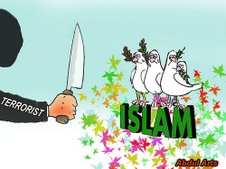
Here is a cartoon that shows a terrorist killed by the white crescent of the green flag of Islam....because I wish the terrorists and jihadists to go to hell.

I want to show that the moderate Muslim majority rejects terrorism. Jihadists plan to kill all believers in the world - Christians, Jews, and others. We real Muslims believe in the solidarity of all humans and wish for peace.

I can't talk about what is going on in my own country, Somali, because of these maniacs. Just this week some Somali jihadists from a group called Hizbul Shabaab (Alshabab Group) sent me a threatening email because I published a cartoon about suicide terrorism.

The jihadists threaten all people of good faith. As I said, I wish they would go to hell.

Eid Mubarak,

Abdul

Friday, October 12, 2007

From me to all of you who are celebrating


Thanks to Abdul Arts, the Somali cartoonist in Egypt, for making this for me. May God reward your piety.

Wednesday, October 10, 2007

The face of a unified Iraq


Imagine what Iraq could look like were the sects to lay down arms. Our Somali cartoonist in Egypt, Abdul Arts, did just that - rather, he imagined what a unified Iraqi would look like. The slight green pallor on the face is a reflection of the Iraqi flag. Looks like a nice guy.

Saturday, October 6, 2007

Interview with a Pakistani photographer


The photographer, Kamran Safdar.
1. Who are you?

My name is Kamran Safdar and I am from Taxila, a little town near Islamabad, the capital of Pakistan. Taxila is famous for its Buddhist history and ancient ruins, and is on the United Nations' World Heritage List. Otherwise it is a dusty little town where people go to bed at eight and the entire city is dark by nine.

Ancient ruins, Taxila.

2. Why do you take the pictures you do?


Taking picture is just a hobby, I started to travel and hike to the northern mountainous areas of Pakistan back in 1999 and the usual vacation shots eventually became a serious passion.

3. What is your day job then? I have to say, your photos are so exquisite, you write so well, and you have such a distinct vision, that it is hard to believe you have not been discovered yet by the magazine world.

I work as an IT professional at a University in Taxila where I mainly teach software programming to mechanical engineers.

In my spare time I love to write poetry, paint, and study any book I can get my hands on that isn't related to IT.

4. Are you a local or a stranger to the people you photograph?

While I am a Pakistani, I don't have to travel far to find myself in an entirely different culture. Pakistan is very diverse that way, language and customs can change very quickly in this part of the world. So, again, I don't have to venture very far geographically to find myself in completely unfamiliar territory.

Swati brothers.

5. Did you have to discover all these beautiful places on your own or did you always know about them?

Before 1999 I didn't know very much about the rest of the Pakistan, and especially the mountainous regions. But after I discovered the Kaghan Valley in the lower Himalayas, I started reading everything I could find about travel in Pakistan and by now I've visited quite a few places, especially in the mountains. In addition to the travel guides, I also ask the locals for their recommendations. I have to say, they've pointed me to some exquisite places that weren't in the guide books.

6. Tell us about some of your favorite areas and subjects?

My favorite place in Pakistan is the Chitral Valley - because of its physical beauty and the hospitality and friendliness of the people who live there. I love going back there and I have many cherished memories from my visits there.

This is an area right next to Afghanistan, in the northwest of Pakistan. The people who live there are strict Muslims but they would never harm anyone and a stranger is a guest in their land. I have spent many a night in the homes of locals who, though I was a total stranger to them, still were happy to open up their home and hospitality to me.

I am always keen to learn about the culture of the areas I travel to, and my special interest is women and children. It is especially challenging to photograph them as while many may not cover their face, they still don't like the idea of being photographed by a stranger, and especially a man. I think I'm fascinated by the women because their lives are the most hidden part of these cultures.

Children are another important subject to me. I like to find out as much as I can about their lives - whether they have access to medical facilities, where they go to school, if the girls go to school as well, how many miles they have to walk to get to school, and how hard it is for them during the winter, once the snow falls. In the mountains, life is pretty hard in the winter.

A Swati girl.

Nomad boy, Swat.

7. Have you traveled there in winter as well yet?

I have not traveled to the north in the winters mainly because I get vacations in the summer and the roads and treks are all closed. Some parts are cut off from rest of the country for the entire winter season. The only way in and out is to fly in on Fokker planes which are always overbooked. But even during summer, the north is quite cold by my standard.

8. I'm sure you've read all the reports about Al Qaeda hiding in the frontier areas of Pakistan. Can you square these reports with your experience?

I have traveled throughout much of the north and northwestern areas of Pakistan but I avoid the tribal areas that are said to be hostile to strangers. These are the areas where Al Qaida is said to have taken refuge and where the Taliban get their local support and recruits. This is the area called Waziristan, which is the strip closest to Afghanistan. Before the rise of the Taliban and Al Qaida, the tribes in this area operated smuggling rings and other criminal enterprises. Even during the British Raj, the English found they couldn't control these areas, so they too avoided going there.

9. What about the school girls in Swat Valley who are reportedly being menaced by the Taliban? What are the parents doing to protect them?


I'm surprised that Swat is facing this kind of menace as it has long been a tourist paradise. It was once a hippie paradise filled with foreigners. Today, it is a favorite spot for Pakistanis because of the pleasant weather and beautiful landscape. There are hotels everywhere in the valley and every kind of tourist facility you would expect.

An idea of the terrain.

Honestly, I have not heard any reports of any girls' schools being menaced there but if this did happen, it must have been in the Waziristan region. There I understand people are forced to keep beard and such.

10. Here is a link to a UN report on what girls are reportedly being forced to endure in Swat: www.worldpress.org/Asia/2822.cfm. Does it ring true to you?

Yes, it does, I'm sorry to say. Notice that the report says that the girls schools are being attacked in the Malakand Agency. The term Agency means that this is a tribal area, which means an area over which the government has little control.

Waziristan, the Malakand Agency, and the tribal strip are located in the dark green area.
Chitral is located in the pink region. Taxila, where Kamran lives, is marked by a T.


11. So is Islamic extremism widespread in these frontier areas?

Yes and no. It is true that in some really backward areas, people have little understanding of Islam in that they have no clue it is actually a religion of peace, and has nothing to do with imposing religion or practices on others.

But the majority of Pakistanis are so far removed from the Taliban and cannot be considered extremists by any stretch of the imagination. So we need to understand that when we hear of Al Qaida or extremists in Pakistan, they are not everywhere but only in particular tribal places.

12. So what to do about the extremism?

The factors that contribute to extremism, I believe, are multinational as well as local. Pakistan and Pakistanis by themselves cannot eradicate extremism.

The roots of extremism are somewhere in Afganistan. Then you have to find where the funds come from. What decades of jihad in Afghanistan created will take time to cleanup.

The war against terrorism has severely and negatively impacted Pakistan. Being next door to Al Qaeda has meant that Pakistanis have too often been an easy target of Al Qaida's vengeance.

As long as the Taliban are able to operate in Afghanistan, Afghan mujahidin will continue to infiltrate Pakistan's tribal areas, and will have influence over a small segment of our population. This is because, simply put, the Pakistani tribals see the Taliban as Mujahidin, or Islam's holy warriors, protectors of the faith.

Tribal areas like Waziristan have always been semi-independent from the central government. This means that they can only be loosely monitored, as all local issues are handled by tribal elders and their Jirga (Council) . Also the tribes don't recognize that there is a border with Afghanistan as this border divides their historical land and it's always been entirely routine for them to come and go as they please.

Their remoteness means they haven't had much interaction with the modern world. They don't have many schools, medical facilities, or roads in these areas. They still live pretty much as they did 100 years ago. As I said earlier, even the British Raj gave up trying to control these areas. The Pakistani government hasn't been able to govern them either, not really.

The tribals truly believe they are following Islam and they will protect the extremist Taliban mujahideen as their guests because this is their tribal code of honor. In the past few months, the Pakistani Army initiated several military attacks in the region, but they haven't made much progress and the cost in lives has been high. These areas are very similar to the tribal areas in Afghanistan. I'm sure I don't need to point out that in six years, the U.S. has been unable to eradicate Al Qaida and the Taliban in these same types of areas in Afghanistan.

I believe the end of extremism and militancy will come with development - in Afghanistan and the tribal strip of Pakistan. The construction of roads, schools, modern medical facilities, clean water systems, electricity, etc. are what is needed to change the mentality of these people. They will appreciate the modern facilities, they will send their youth to the cities for higher education and to work, and when the youth then return, they themselves will bring the necessary changes that will modify the extremist and intolerant mindset.

I can see that this is what happened in the Swat and Kalash Valleys. It was a pleasant surprise for me to discover a little shop in a tiny village in Swat where I could access a computer and the Internet when I needed to download pictures from my camera. I was even more amazed when the shopkeeper began telling me how much time he spends on the Internet himself, downloading songs, etc. He also spoke about his many visits to Lahore and other cities. You see things can change and modernize, but with development and not military operations and these changes can't happen overnight.

I saw something similar among the Kalasha people, who are supposedly decedents of Alexander the Great's army, who still follow a centuries old religion and tradition. Today they all have access to modern health clinics, schools, roads, clean water, thanks to the efforts of many local and foreign NGOs who work for the social uplift of the region. The girls in this area not only speak their own language, but also Urdu, our national language, and now they study English, too. The head of the Kalasha tribe is a woman, Lakshan Bebe, who was educated abroad. Many of the Kalasha boys go to Karachi and other cities for their higher education and when they return, they do so having with a new and modern point of view.

So I strongly believe that development is the key to ending extremism.

13. What do you wish Americans or Westerners in general understood about Pakistan?

First I wish they understood that the vast majority of Pakistan is safe and that the vast majority of Pakistani people are both friendly and hospitable, that they are not at all intolerant, and have nothing against Americans or Westerners. Again, the vast majority of Pakistanis are not fanatic Muslims and they are nothing like the Afghan Taliban.

There seems to be to be a constant stream of media disinformation that makes Pakistan look like a pro-Taliban state which it most definitely is not.

Taxila school kids.

14. Any comments about Pakistan's upcoming elections?

Pakistan was founded as a democratic republic and Pakistanis have always struggled against military rule and dictatorship. In the previous election, two major political parties had their leadership expelled which paved the way for the religious parties to win more seats than they would have otherwise.

General Musharaf has had eight years now to prove himself. There has been little economic growth, and he has used the issues of terrorism and extremism as excuses to stay in power.

He allied himself with the US in the fight against terrorism only to sustain his military rule. How ironic is it that for past five years, the military regime while purporting to be enlightened and moderate, has governed the country by soliciting help from the mullahs? Musharaf has never seriously tried to uproot the extremists from their hub. The reason for this? He needs them as his excuse to stay in power.

Pakistanis are still hopeful that the upcoming election will restore democracy in Pakistan, that we will have mainstream political leaders back in the country, and that finally we can be governed by elected representatives.

Thank you for sharing your thoughts here. Really, your work is fantastic.