traffic analysis

Showing posts with label Sunni versus Shia in Iraq. Show all posts

Saturday, June 16, 2007

If you think some Westerners have a bad case of Islamophobia

How would you characterize the perpetrators of all the mosque bombings in Iraq?

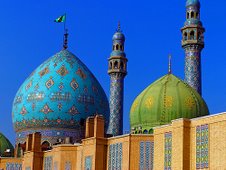
What made me think of this was the New York Times report that a second Sunni mosque in Basra was blown up today. While this does seem to be in retaliation for the Samarra mosque bombing Wednesday, there doesn't seem to be any end in sight for these kind of sectarian reprisals.

If mosques are the problem some "Islamophobes" contend them to be, at the rate they're going in Iraq, it does seem they won't be a problem there much longer.

I wonder when Iraqis are going to have to ask themselves what all this terror and destruction implies about their faith.

I know that for onlookers, the message seems pretty clear. I mean at what point does all this destruction being carried out in the name of Islam not reflect badly on the religion itself?

While some will surely cling to what they say are the tenets that prohibit such actions, others including today's adherents are going to end up judging Islam itself by these kinds of actions.

Memo to mosque bombers: It's not just the other guy's building you are destroying here.

Wednesday, June 6, 2007

What do experts think of Saudi Arabia's growing influence?

The Atlantic Monthly polled 39 Middle East experts to find out what they thought about Saudi Arabia's growing role in the region. Here are some of the findings:

Only twenty-three percent thought Saudi Arabia would be able to contain Iranian influence in the region. As one expert told the Atlantic:

“Remember, the great advantage the Saudis have (beyond money) in the region is that they are Arabs the Iranians are Persians. This alone limits the power the Iranians have over the entire region and is a tremendous demographic asset for the Saudis.”

But only sixteen percent thought Saudi involvement would increase sectarian violence between Sunnis and Shias and five percent thought that Saudi Arabia's growing role could actually heighten the possibility of a conventional war between Iran and the Sunni Arab states.

Only two percent thought the Saudis could contain Iran's influence in Iraq.

Sixty-nine percent thought that Saudi Arabia would remain "friendly enough" to U.S. interests over the next five years.

Many seemed to indicate that King Abdullah was an important factor in the good relations.

As one expert reportedly said: "Saudi Arabia under King Abdullah is a very responsible and important nation. They remain better friends to the United States than we deserve.”

Another expert had this to say:

“Riyadh has no illusions about what Iran's ascendancy means for the region--or why it [needs] the United States as an ally. So the House of Saud won't venture too far from Washington's side.”

Another suggested that any good will on either side is only the result of each countries' oil dependence:
“Saudi Arabia is good on oil and bad on virtually everything else. As long as we're so addicted to that oil, it—and, sadly, we—are friendly enough.”

Monday, May 28, 2007

Michael Yon: It's not about Sunnis versus Shia in Iraq

Blogger and combat journalist Michael Yon sends this from his email from Iraq (via Instapundit):

Iraqis have told me many times that the larger part of this war is not about religion. Fanatical groups such as al Qaeda surely have wreaked havoc, but a huge part of the war is about business, influence and resources. The American Commanding General, David Petraeus, has said repeatedly that money is ammunition in this war. The meetings I attend with local leaders around Iraq are never about religion. Religion is seldom if ever brought up. The meetings are about security, electricity, jobs, water projects. The meetings often are about influence, and politics fit for a novel.