traffic analysis

Thursday, March 1, 2007

Another arrest in the British "airplanes" plot

CNN is reporting that another suspect has been arrested in connection the "airplanes" plot that was discovered last summer in Britain. Fourteen out of 24 persons that were originally arrested remain in custody and now, this fifteenth person, a 27-year-old man who was arrested in the Waltham Forest area of London, according to the London police.
No information was released regarding his specific role in the plot. As CNN reports:

Security sources said the alleged plotters intended to use an electrical charge to detonate liquid explosives in planes as they flew at maximum cruising altitude over the Atlantic Ocean, making it difficult for investigators to retrieve evidence.
These are some interesting details:

According to a British intelligence official, the planned near-simultaneous attacks -- which one top U.S. official said were intended to be "a second September 11" -- were foiled when a member of the country's Muslim community contacted authorities after noticing an acquaintance acting suspiciously.

An undercover British agent then infiltrated the group to gather information, U.S. government officials told CNN.


Digg!

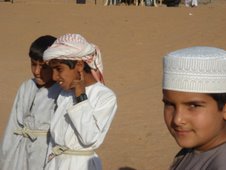
Shooting on Horse Games in the Lorestan Province of Iran


I swear, the minute Iran and the U.S. sort out their issues, this is where I'm headed.


Update: A reader asks: What are they shooting at?

Wednesday, February 28, 2007

Let the races begin


Courtesy of Reuters

The annual Camel Race Festival in Egypt has begun. I know this will probably mark me for cultural retraining, but I have to admit that I'm a fan of camel racing, and yes, hunting with falcons, too. (From today's New York Times.)

Geocities


Digg!

Is this what's wrong with today's war coverage?

Mark Moyar makes some interesting points about the mainstream media's war coverage in today's New York Sun:

The Vietnam-era journalists began a tradition that today's press consistently upholds. We hear very little from most large press outlets about American heroes in Iraq and Afghanistan, men like James Coffman Jr., Danny Dietz, and Christopher Adlesperger, or about our military successes there. Instead of associating such names with these wars, Americans associate the words they hear most often from the press, like Abu Ghraib and Haditha. As in Vietnam, too, the shunning of heroes does not extend to the press's coverage of itself. Awards to journalists, both those who have spent time in Iraq and Afghanistan and those who have not, are considered worthy of lengthy news stories.

Publicizing American heroism and success is essential today for two reasons. First, it permits a nuanced view of Iraq and Afghanistan, one which cannot be discerned from the daily stories of sectarian murders and the photos of American troops who have just been killed. Second, American troops and the American people become more courageous and resolute when they hear of their countrymen's military heroism and success, past and present. In earlier times, Americans ingrained their traditions of heroism and victory into the country's youth through historical instruction. Today's history textbooks largely ignore America's military past, a reflection of the anti-military prejudices, lack of military experience, and cosmopolitanism that pervade the intelligentsia.

Most Americans outside of academia and the mainstream press, on the other hand, still understand the importance of military tradition, and they crave stories about valorous Americans at war. We are fortunate, therefore, to have "Don't Tread on Me: A 400-Year History of America at War, From Indian Fighting to Terrorist Hunting" (Crown, 464 pages, $27.50) to satisfy that yearning. In witty and irreverent prose, author H.W. Crocker III provides a broad survey of America's martial history, starting at the arrival of the first English colonists and ending with the present wars in Iraq and Afghanistan. Among the great military men whom Mr. Crocker profiles are some who remain widely known because they later became president (Jackson, Taylor, Theodore Roosevelt), or because their renown is too enormous to hide (Douglas MacArthur, George Patton). But most are men whose fame has been dimmed by the neglect of the cultural elites.

Digg!

Saudi Arabia: The beginnings of a knowledge-based society?

The Arab News, Saudi Arabia's English-language daily, reports that the Riyadh International Book Fair 2007 which opened Tuesday, will feature over 200,000 books and hundreds of publishing houses from the Arab world. As the Arab News reports:

Shoura Council member Muhammad Al-Zulfa described the event as “a national treasure.” “This is a national day in which we salute our poets, our authors and our thinkers,” he said, adding that the event plays an important role in Arab and Islamic culture, not just Saudi Arabia.

“Here in Riyadh we are proving to the world that we are a nation that embraces culture, civilization and productivity despite a small minority among us trying to cocoon us in a small environment isolated from world culture,” he said.

He said by sponsoring such an international book exhibition, Saudis joined hands in combating the ideology of an extreme minority in the Kingdom who refuses to open up to the world.

Recall that it was only a few years ago that the United Nations in the Arab Human Development Report 2002 revealed the following surely embarrassing facts:
The Arab world translates about 330 books annually, one fifth of the number that Greece translates. The cumulative total of translated books since the Caliph Maa'moun's time (the ninth century) is about 100,000, almost the average that Spain translates in one year (Galal, S., 1999).
The Riyadh Book Fair would seem to be an indication that the Saudis are serious about addressing at least part of the knowledge deficit the UN report was talking about.

Update: Bernie expresses some skepticism:
What booth would I find[1] Writings of Martin Buber, IB Singer, and Philip Roth, and[2] What booth would I NOT find the Protocols of the Elders of Zion!

Is this our greatest hope for peace in Iraq?

You should really check out FARS, the Iranian news agency for its photography content alone. The articles offer a real window on what's going on in the Islamic Republic too.


Digg!

It's a cold day in Tehran

In spite of the apparent heat wave coming across the Atlantic. But it sure seems to be cozy in the Majles-e Shura or Iranian parliament.


Digg!

Tuesday, February 27, 2007

No more safe haven in Britain for Abu Qatada, Al Qaeda's "spiritual advisor"

The New York Times reports that a British court has finally ruled that the government can deport a leading Al Qaeda spiritual advisor to Jordan, even though the country doesn't have a human rights record that would meet European standards.

Al Qaeda's advisor in this case is Abu Qatada who was convicted in absentia in his homeland of Jordan on bombing and conspiracy charges (along with his devoted follower, Abu Musab al-Zarqawi, the head of Al Qaeda in Iraq until his death in 2006).

Abu Qatada's significance to the organization can be deduced by the fact that tapes of his sermons were found in the possession of lead 9/11 hijacker, Mohamed Atta, as well as Richard C. Reid, the would-be shoe bomber. He was also the person the Madrid train bombers tried to call to get permission to kill themselves before they blew themselves up to avoid being arrested, according to Lawrence Wright of the New Yorker.

Abu Qatada also ran what Wright describes as the "first jihadi think tank," a magazine that was published out of London during the 1990s called Al Ansar. As the magazine was a vocifierous proponent of the jihad in Algeria, Abu Qatada came to be identified with the GIA, the outfit that gained notoriety for slitting the throats and otherwise massacring tens of thousands of Algerian villagers who the organization deemed to be insufficiently helpful to the jihad.

It was during his tenure at the magazine that Abu Qatada became familiar with Zarqawi, incidentally, when he covered Zarqawi's sedition trial in Jordan. According to Seif al-Adl, another Al Qaeda leader, it was Abu Qatada who introduced Zarqawi to Bin Laden and Zawahiri.

Zarqawi ran Al Qaeda in Iraq and was the person responsible for most grisly attacks against civilian targets from 2003 until his death in June last year. His attacks included the Samarra mosque bombing, the event which finally pitted the Shiites against the Sunnis and launched what many describe as Iraq's civil war.

It was also Zarqawi who was behind most of the hostage beheadings, including those of the American contractor, Nicholas Berg and Ken Bigley, the British hostage, which he personally carried out. He also orchestrated the 2005 hotel bombings in his native Jordan, suicide bombings that killed some 70 people, mostly members of a Palestinian family attending a wedding.

Given that these were the types of seeds Abu Qatada has sown, it should not be entirely surprising that Britain would want to be rid of this person. But it wasn't until the July 7, 2005 subway and train bombings, that the British government felt that Abu Qatada's right to live in Britain safely away from Jordanian authorities weighed less than the personal security of Britons, whose lives he was putting in danger with his fiery sermons and various writings.

Human rights advocates and Abu Qatada's attorneys, however, argued until the very last moment that au contraire, the human rights of men like Abu Qatada should prevail over any national security concerns. In particular, they objected to the fact that upon his return to Jordan where he would be headed for prison, he could likely be subject to torture.

The court rejected the defense's arguments in the end, saying that given that Jordanian authorities had promised to refrain from torturing returning terrorism suspects, and had further agreed to monitor the conditions of those incarcerated that should be all the protection that Abu Qatada should require.

Indeed.

Monday, February 26, 2007

The WSJ raises some serious questions about today's NATO

In today's Wall Street Journal, the editors discuss the implications of Italy's decision to indict the 25 CIA agents, U.S. Air Force officer, and five Italian intelligence agents who allegedly kidnapped a terrorist recruiter in 2003 and "rendered" him to his native Egypt, so they could torture him to extract information about his various activities.

The WSJ characterizes the charges as "Exhibit A in how European politicians are working against the U.S., undermining the fight against Islamic terrorism and endangering the NATO alliance." As the WSJ points out:

[No] one, including the Italian prosecutors, doubts that [the recruiter, Osama Mustafa Hassan Nasr,] posed a security risk. In 2005, a Milan court, at [the prosecutor's] behest, issued an arrest warrant for Nasr, charging him with building a terrorist network in Europe that actively recruited terrorists, including for Iraq. Eight of his accomplices have been sentenced to up to 10 years in prison on similar charges, and Italian authorities believe more are at large.
The WSJ acknowledges that the strategy in dealing with Nasr this way isn't obvious. To quote the Journal:
Why Nasr was captured rather than arrested in 2003 isn't clear. According to a July 2005 story in the New York Times, which cited unnamed current and former American officials, the CIA was concerned that Nasr was plotting to attack the U.S. Embassy in Rome. For whatever reason, the U.S. wanted him off the streets while the Italians weren't ready to arrest him. The CIA won't comment. The government of Silvio Berlusconi -- who was Prime Minister at the time -- denied any foreknowledge of the rendition.
But regardless of the reasons for the action, as the WSJ goes on to explain:
No one seriously claims, however, that the CIA agents were in Italy without the explicit knowledge and participation of Italy's security services. This is the crucial point -- and explains why the indictments are a hostile act against the U.S. By long-established international legal practice, the official agents of one country operating in another with that state's permission are immune from prosecution.
As the WSJ concludes:
European politicians are more at fault here than any prosecutor. Since the 9/11 attacks in the U.S., many European leaders have been playing a double game, working with the U.S. to root out terrorist plots on the sly -- and saving countless lives -- while publicly condemning "American methods" in rhetoric that has fed rising anti-Americanism...

European officials need to understand the risks they're running if they keep this up. Italy and the U.S. are NATO partners, but such an alliance is meaningless if "allies" make a habit of prosecuting each other for cooperating against a common threat. Italy's political grandstanding is endangering NATO, as well as the lives of millions on both sides of the Atlantic.
But do read the whole thing.

Digg!

"Independent" Joe Lieberman weighs in on Iraq

In today's Wall Street Journal, the "Independent" U.S. Senator from Connecticut writes about the situation in Iraq - and the far more distressing political fight about Iraq going on in Washington:

What is remarkable about this state of affairs in Washington is just how removed it is from what is actually happening in Iraq. There, the battle of Baghdad is now under way...

[The] fact is that we are in a different place in Iraq today from even just a month ago--with a new strategy, a new commander, and more troops on the ground. We are now in a stronger position to ensure basic security--and with that, we are in a stronger position to marginalize the extremists and strengthen the moderates; a stronger position to foster the economic activity that will drain the insurgency and militias of public support; and a stronger position to press the Iraqi government to make the tough decisions that everyone acknowledges are necessary for progress.

Unfortunately, for many congressional opponents of the war, none of this seems to matter. As the battle of Baghdad just gets underway, they have already made up their minds about America's cause in Iraq, declaring their intention to put an end to the mission before we have had the time to see whether our new plan will work.

There is of course a direct and straightforward way that Congress could end the war, consistent with its authority under the Constitution: by cutting off funds. Yet this option is not being proposed. Critics of the war instead are planning to constrain and squeeze the current strategy and troops by a thousand cuts and conditions...

Many of the worst errors in Iraq arose precisely because the Bush administration best-cased what would happen after Saddam was overthrown. Now many opponents of the war are making the very same best-case mistake--assuming we can pull back in the midst of a critical battle with impunity, even arguing that our retreat will reduce the terrorism and sectarian violence in Iraq.

In fact, halting the current security operation at midpoint, as virtually all of the congressional proposals seek to do, would have devastating consequences. It would put thousands of American troops already deployed in the heart of Baghdad in even greater danger--forced to choose between trying to hold their position without the required reinforcements or, more likely, abandoning them outright. A precipitous pullout would leave a gaping security vacuum in its wake, which terrorists, insurgents, militias and Iran would rush to fill--probably resulting in a spiral of ethnic cleansing and slaughter on a scale as yet unseen in Iraq.

Recall that Senator Lieberman was the Democratic Vice Presidential running mate of Al Gore in the 2000 presidential elections and would have been a fourth-term Democratic U.S. Senator from Connecticut had he not lost the Democratic primary election to Ned Lamont in 2006, causing him to run - and win- as an independent.

Anyway, read the whole thing. (Yes, you too, Bernie.)

Digg!

Sunday, February 25, 2007

And now let's hear directly from an Iraqi living in Baghdad

Mohammed at Iraq the Model writes:

It's been less than two weeks since the Baghdad operation was officially launched. This period, though short, has been full of events; both good and bad ones. Here we are not in a rush to judge the operation unlike some media or politicians who seek anything they can use to serve their agendas. We, Baghdadis, only want this operation to succeed and we still have some patience to show.

Digg!

The opposition to the Baghdad Security Plan makes itself heard

Just as Baghdad seemed to be getting more secure, a female suicide bomber blew herself up at a Baghdad university on Sunday, killing herself and at least 40 others. This was among several explosions to hit the Iraqi capital today, making it one of the worst days in terms of violence since the start of the new Baghdad security plan according to a New York Times report.

Oddly, the radical Shiite cleric Moktada Al-Sadr took today's violence as the opportunity to distance himself from the Baghdad security plan up that up until this point he seemed to have been endorsing. He issued a written statement that was read to his supporters at a site near the blast in which he urged them to to cease cooperating with the United States military.

“There is no good that comes from a security plan controlled by our enemies, the occupiers,” the statement said. “If you stay away from them, God will protect you from horror and harm. Make sure your plans are purely Iraqi and not sectarian.”
Go figure.

Meanwhile at the university site where the blast occured, the Times went on to report:

Hussain Ali al-Mousawi, a middle-aged blacksmith who said he lived across the street from the university, collected body parts on a notebook, placing severed fingers, pieces of skull and bloody flesh on pages covered with a student’s jottings notes on subjects like income brackets. His shirt was covered with blood. He said he had been carrying bodies; the sleeves of his beige cotton, striped shirt were soaked bright red.

...“We are burying here the minds of our society,” he said, pointing to the ad hoc graves dug by Mr. Mousawi. “We are planting them anew. How many of our great minds have they killed? They are targeting the students who are carrying pencils — our dirty neighbors.”

“We shall reconstruct the great Iraqi mind from the beginning,” Mr. Hasan said. “This land will produce more minds than ever.”


Digg!

MSM on Iraq: Good news is no news

Conservative writer Patrick Ruffini has an interesting observation on news reporting in Iraq. In Townhall.com he writes:

Early indications are that the troop surge into Baghdad is working. It hasn't been reported on widely, but murders in Baghdad are down 70%, attacks are down 80%, Mahdi Army chief Moqtada al-Sadr has reportedly made off for Iran, and many Baghdadis who had fled the violence now feel it's safe enough to return.

The strategy that Congress is busy denouncing is proving to be our best hope for victory. In Iraq, there's a sense that change is in the air -- literally. Omar of Iraq the Model spots a B-1 Bomber in the skies of Baghdad for the first time since the end of the major combat. On the ground, Omar writes that the signs that Iraqis are getting serious about security are more palbable.

With the help of Compstat-like technology, security forces are cracking down at checkpoints (even ambulances are getting stopped) and getting nimbler about locating them strategically so the terrorists don't know what to expect. This turnaround in Baghdad is confirmed at home by the media's near-deafening silence.

If it seems like you've heard less about how Iraq is spiraling into civil war in the weeks since the surge was announced, this is why. Even some discordant voices in the media are starting to wonder what's happening. Time magazine worries that it's "Quiet in Baghdad. Too quiet." That's right -- a dramatic reduction in violence is actually bad news.

Digg!

MI5: Threat of al-Qaeda attack in Britain now highest since 9/11

Today's London Telegraph reports that "secret intelligence documents reveal" that "the terrorist threat facing Britain from home-grown al-Qaeda agents is higher than at any time since the September 11 attacks in 2001."

This follows a November report by Eliza Manningham-Buller, the Director-General of MI5, Britain's domestic spy agency, that warned there were some 1,600 'identified individuals" actively plotting terror in Britain, in 30 known networks, working on at least 30 different terrorist plots.

The secret document, says the Telegraph, also claims that al-Qaeda is now a "world-wide organisation with a foothold in virtually every Muslim country in North Africa, the Middle East and central Asia."


Digg!

Saturday, February 24, 2007

Where's Sadr?

We still don't seem to know, but he seems to be getting his troops in line.

Today's New York Times has a must-read article. Damien Cave reports that when Moktada al-Sadr, "the radical Shiite cleric" found that "two of his commanders had created DVDs of their men killing Sunnis in Baghdad" along with evidence they were being funded by Iran, he immediately "stripped them of power."

Now Cave wasn't able to say whether this was because Sadr was on-board with the new security plan for Baghdad, or whether, as Cave writes, he "grasped the risk of graphic videos and ties to Tehran and wanted to stave off direct American action against him."

But whatever the case, as the Times reports:

For now, American and Iraqi officials say that Mr. Sadr seems to be cooperating with the effort to pacify Baghdad, ordering his men not to fight even as American armored vehicles roll into Mahdi strongholds in eastern Baghdad. And he seems to be cleaning house of fighters who could taint him by association with Iran or with death squad killings. The assassinations and mass kidnapping of Sunnis that are often attributed to his militia seem to have decreased.

Morever:

Mr. Sadr has [even] assisted the joint Iraqi-American campaign against parts of his militia, signaling whom to arrest and telling others to flee, said two Mahdi commanders and a Shiite politician in Baghdad. And on his own, they said, Mr. Sadr has “frozen” more than 40 commanders, including about 20 with links to Iran. ...

According to Sadr aides and Mahdi commanders, Mr. Sadr’s recent purges aim to put Iran on notice that he is in charge and independent. They said he also wanted to remind members of his militia that he would use every available tool, including Iraqi and American troops, to maintain control of the militia, the source of any political power he wields.

Digg!

Friday, February 23, 2007

Arab Gulf states growing anxious about Iran


The New York Times reports that the Arab Gulf states "have begun a rare show of muscle flexing, publicly advertising a shopping spree for new weapons and openly discussing their security concerns."

These states, the United Arab Emirates, Saudi Arabia, Oman, Bahrain, and Qatar, "normally prone to squabbling," the Times writes, are now "[emphasizing] their unanimity against Iran's nuclear ambitions." This is because, the Times says, they "see themselves as the likely first targets of an Iranian attack."

Emile el-Hokayem, a research fellow at the Henry L. Stimson Center, told the Times that the Gulf states are telegraphing a message to the world with this new openess. "The message is first, 'U.S., stay involved here,' and second, 'Iran, we will maintain a technological edge, no matter what.'"

Aside from today's news that Iran is ahead of some experts' estimates with respect to its program to enrich uranium (seen as the first step in creating a bomb), Iran's recent military maneuvers in the Strait of Hormuz have also alarmed its Arab neighbors. This is the waterway through which two-fifths of the world's oil supply moves and all of these Arab Gulf states depend on a stable flow of oil for their very survival.

The U.S. recently sent a second aircraft carrier to the Persian Gulf, in addition to an increased number of minesweeping vessels. The U.S. denies that any kind of military strike against Iran is imminent.

The indication is that the Bush administration is hoping that more punitive sanctions backed up by the possibility of force will in the end be enough to persuade the regime in Tehran to abandon any ambitions it might be entertaining regarding a nuclear bomb. An ambition the Iranians insist is not part of their scheme.

Do Iraqis understand how poorly stories like these play in America?

And if they do, what is the message here?

As American forces sweep through Baghdad at considerable risk to themselves, trying to disarm Iraqi militias, reports such as the following about Shiite policemen are not encouraging.

Today's New York Times quotes a "translator working with the Americans" who claims he overheard Iraqi police "telling people in the neighborhood to hide your weapons from the Americans." While its not clear whether or not this translator may have an agenda from the Times report, his account seems to be at least somewhat corroborated by Americans in positions to know.

First Lt. Andy Moffit, a platoon leader, told the Times that "the major problem with Iraqi forces is not their tactical skill, but their 'loyalties and integrity.'"

As the Times reports, the cost in American blood has been high in this effort to bring peace to Baghdad. Since American troops have, as the Times puts it "increasingly returned to the front lines in Baghdad....they have suffered an average of 85 deaths a month since then [August] - a 50 percent increase over the previous six months."

The Times goes on to report (again, not helping the Iraqi case):

Even routine security tasks performed by Iraqi forces, such as operating traffic checkpoints, are frequently underminded by laziness, American troops say, if not outright sabotage through complicity with the militias.
If Iraqis want American assistance to continue, let's hope they figure out sooner rather than later that news like this doesn't play very well in America.

What about the consequences of criminalizing warfare?

David B. Rivkin, Jr. and Lee A. Casey raise a critical question in an op-ed piece in today's Wall Street Journal.

Using the term "lawfare" to describe the "blizzard of litigation initiated in U.S. federal courts on behalf of al Qaeda and Taliban detainees" the former Department of Justice officials refer to the lawsuits that, in their words, "range from habeas corpus petitions...to tort suits seeking monies from U.S. government officials, to challenges regarding the detainees' conditions of confinement."

Along with the litigation, as Rivkin and Casey write, "[then there are the 'progressive'] NGOs [who] routinely demand that irregular enemy combatants like al Qaeda and the Taliban can be treated as POWs or criminal defendants, claim that military force can be applied only to the minimum amounts necessary to neutralize a particular opponent (rather than with a view to achieving ultimate victory), [and who aim] to ban an increasing number of weapons and weapons systems as being 'inherently indiscriminate.'" They argue that:

The effect of this lawfare effort, were it successful, would be to make it exceptionally difficult - if not impossible- for a law-abiding state to wage war in anything like the tradtional manner, bringing the full weight of the national armed forces to bear against an enemy, without prompting charges of war crimes and efforts to intimidate individual officials with prosecutions on ersatz 'war crimes' theories.
While this may be all well and good in theory, it would seem that Messrs. Rivkin and Casey raise a point point worth considering: Exactly what alternative method do those who would criminalize war suggest should be used to "[ensure] the welfare and security of the civilian populations that the armed forces of states, and of the U.S. in particular, are raised and maintained to protect"?

Australia isn't going wobbly

Today's Financial Times reports:

Brendan Nelson, the Australian defence minister, signalled on Thursday that his government might double its troop deployment to Afghanistan and will resist calls to draw down forces in Iraq.

Mr Nelson said he was concerned by reports that Taliban and other insurgents were planning a big spring offensive. “It’s hard for us in Australia to see it but it’s essential that we prevail,” he added.

Thursday, February 22, 2007

"Monkey" Egyptian blogger Abdul Kareem sentenced

The (London) Guardian reports that 22-year-old Egyptian blogger Abdel-Karim Nabil Suleiman (aka Abdul Kareem), 22, a former law student at Cairo's Al-Azhar University, was sentenced to four years in prison for having insulted Islam and the Egyptian president, Hosni Mubarak.

As the Guardian reports:

Suleiman was one of several bloggers arrested last year, most of whom have connections to Egypt's pro-democracy reform movement. Others were freed but he was put on trial - a sign of the sensitivity of his writings on religion. He was first detained in 2005 after criticising Muslim rioters in a post about sectarian clashes in his neighbourhood headlined The Naked Truth of Islam as I Saw it.

He also described some of the companions of the prophet Muhammad as terrorists and likened Mr Mubarak to the pharaohs who ruled ancient Egypt.

There was no mention of Abdul Kareem's father in the Guardian' coverage of the sentencing hearing. Earlier we cited a news report that says his father called him a monkey, and to add insult to injury, so to speak, that he should be put to death in three days should he refuse to recant his criticisms of Islam