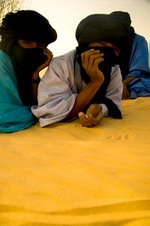
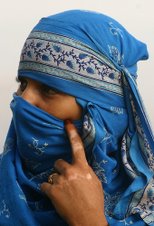
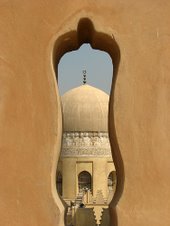
Will Al Qaeda youth now be joining Tuareg bands?
Vanity Fair also has a great article in this month's issue on Mali's annual Festival of the Desert, written by former MTV Networks chairman and Viacom C.E.O. Tom Freston.
He, Jimmy Buffet, the "troubadour of the Caribbean" - as Freston calls him - and Island Records founder Chris Blackwell (among others) attended last year's annual celebration of Tuareg music and culture, that took place, as it has since it began in 2001, in the Sahara desert, 70 km north of Timbuktu.
As Freston writes:
Timbuktu used to sit on the edge of the desert. Today, with desertification, the sands have passed it by on their journey south. The city is inhabited mostly by Tuareg, who are nomadic, very independent, and ethnically different from those who live in southern Mali. There are people in Timbuktu from the Fulani and Songhai tribes as well. The Tuareg have risen up regularly - against the French in colonial times and against the Malian government today. There was a bloody rebellion more than a decade ago, with a lot of fighting in Timbuktu itself. It ended in 1996, with promises of better representation for the Tuareg in the government, and more freedom of movement.Freston and his fellow travelers are among the few Americans who attended last year's festival, he reports, most likely because of the advisory the U.S. State Department had issued just prior to the event, warning Americans that "banditry, factional rivalry, and car jackings" made this "lawless area" unsafe to visit.
Since then it's been mostly quiet on the northern front. Today, Mali is a functioning Muslim democracy. On some levels, it is a study in success. The country is tolerant, diverse, optimistic, and stable. But it's also, and very obviously, one of the world's poorest countries.
Freston was surprised then, that the first festival goers he encountered upon landing in Timbuktu were, well, fellow Americans. He writes:
Three young Americans, all with military buzz cuts and identical wraparound shades, meet us. Turns out they are looking for Jimmy Buffett. Parrotheads in the Sahara. They tell us they are with "the D.O.D." I was unsure what that was, and they clarified ("Department of Defense"). We'll run into them again, but never quite figure out why they're here.As he continues his report, the festival closed with "rousing set from the group Tinariwen" as he explains, the band formed in the rebel camps of Libya, where Colonel Muammar Qaddafi was providing refuge to the Tuaregs in the 1990s. In addition to a safe harbor, the rebels also discovered electric guitars. In the camps, Freston writes:
The young men practice, they write songs about revolution and freedom, and they marry these lyrics to a new electric sound. On top of that, these young Muslims create a band that has (gasp) women in it. Then, in this land of no media, no Internet, the music of Tinariwen travels all over the Sahara by casette and inspires an entire generation of young people. The music is officially banned in Algeria and Mali, which only adds to its allure.Eventually, however, peace comes, and as Freston continues:
The band moves back to Mali, signs an international record deal, gets down to business, and becomes even more popular.I can tell Freston what the other Americans were doing there: they were obviously looking for signs of Al Qaeda, now alleged to have established training camps in the Tuareg region.
Tinariwen's story parallels Mali's more hopeful scenario. Swords turn to guitars, democracy blooms, and music helps bring a sense of national unity. I'm not sure I ever understood what those American soldiers were doing in Mali's desert. But I do know that the American invasion that really made a difference here was one of electric guitars.
So here's a question: Now, assuming that Al Qaeda really is being harbored in Tuareg territory - and this is not at all well established as far as I'm concerned - will the Tuareg change Al Qaeda or will Al Qaeda change the Tuareg?
Because as much as I appreciate Freston's belief that all it took was American-made electric guitars to bring peace and democracy to Mali, I can guarantee that if the Al Qaeda folks are considering staying in these parts, they're not going to see these foreign instruments quite the same way Freston does.
On that note, I'd love to see what measures bin Laden will have to take to keep his teenagers away from next year's festival - assuming, of course, they really are in the Sahel (that is Mali and environs, what used to be the edge of the Sahara).
By the way, you can see the BBC slideshow presentation on last year's Festival in the Desert here.





 Posts
Posts